De Arte Hair Studio

Healthy Scalp Breakthrough Guide: What Causes Scalp Acne and How to Prevent It

What Causes Scalp Acne and How to Prevent It

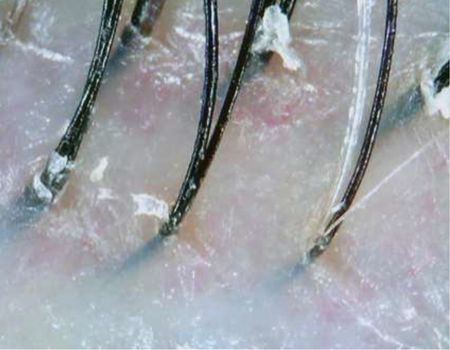
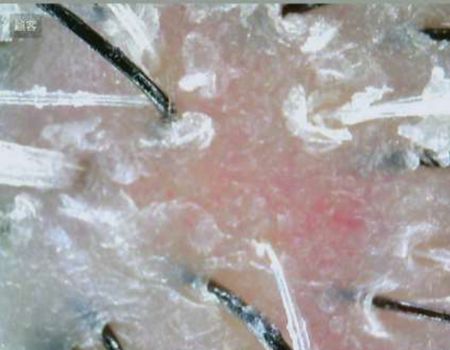
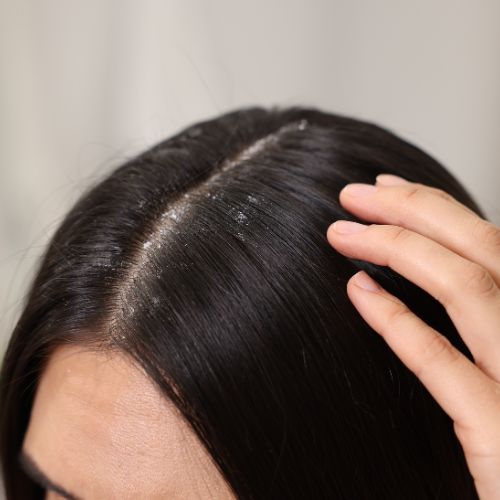
Scalp acne (often called scalp pimples) is a common condition that many people overlook or confuse with dandruff or irritation. In reality, it is a form of follicle inflammation, and it behaves very similarly to facial acne.

The good news? Once you understand how your scalp works like skin, scalp acne becomes much easier to manage and prevent.

What Is Scalp Acne?

Scalp acne is most closely linked to folliculitis, which is inflammation of hair follicles.

It develops when follicles become blocked by:
  • Sebum (natural oil produced by the scalp)
  • Dead skin cells
  • Sweat
  • Product residue
When trapped, these materials can lead to an overgrowth of microorganisms such as:
  • Cutibacterium acnes (bacteria associated with acne)
  • Malassezia (yeast that thrives in oily, humid environments)
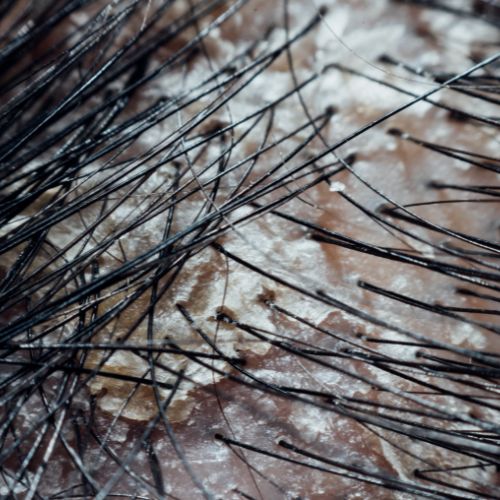
Scalp Acne
Common Symptoms of Scalp Acne
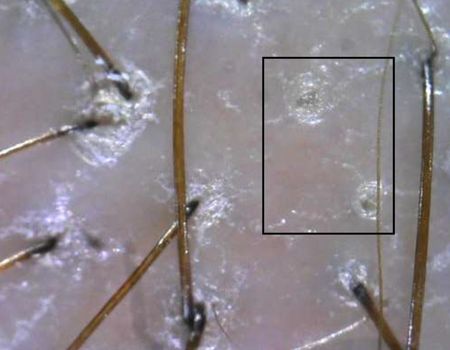
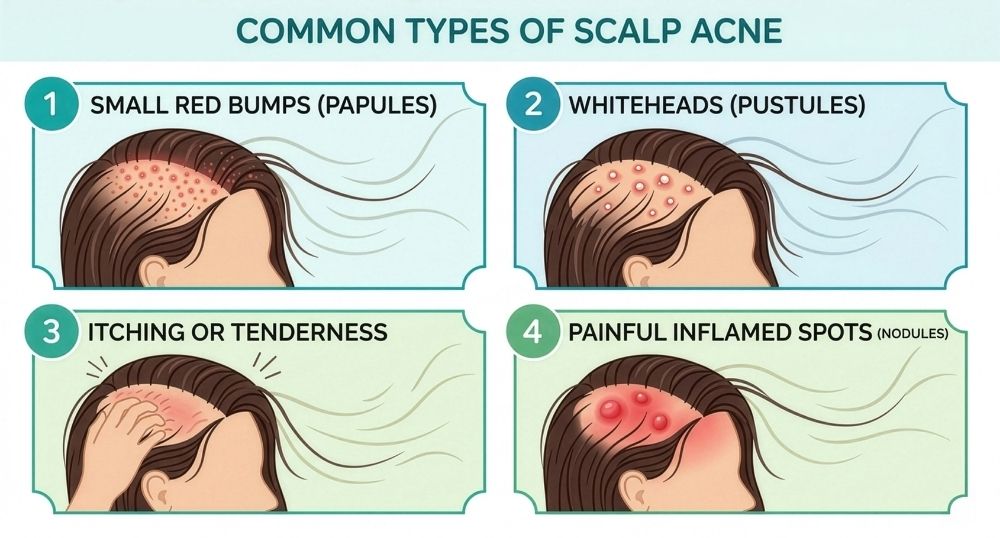
Small red bumps (Papules)

These are early-stage inflammatory acne lesions. Papules appear as tiny, raised red bumps on the scalp that feel firm to the touch. They do not contain pus, but they can feel slightly sore or sensitive. Papules form when hair follicles become irritated or mildly infected due to oil buildup, bacteria, or product residue. They are often the first visible sign that the scalp is becoming inflamed.

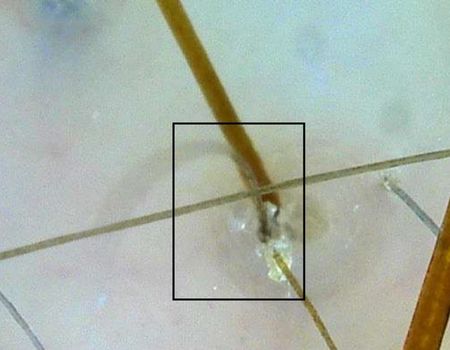
Whiteheads or pus-filled pimples (Pustules)

Pustules are similar to papules but are more advanced. They appear as red bumps with a white or yellow center filled with pus. This pus is made up of white blood cells, bacteria, and debris that the body sends to fight infection. Pustules may be tender or painful and can sometimes burst if irritated. They are commonly associated with clogged follicles and bacterial overgrowth.

Itching or tenderness
Many people with scalp acne experience itchiness or a sore, sensitive scalp even before visible pimples appear. This happens because inflammation irritates the surrounding skin and nerve endings. The sensation can range from mild discomfort to persistent itching, especially in areas with oil buildup, sweat, or product residue.
Occasionally painful inflamed spots (Nodules)
Nodules are a more severe form of scalp acne. They appear as large, deep, and painful lumps under the skin without a visible head. Unlike surface pimples, nodules form deep within the hair follicle and involve more intense inflammation. They tend to last longer, feel hard or swollen, and may increase the risk of scarring if not treated properly.

Scalp acne symptoms can range from mild surface bumps (papules) to deeper, more painful lesions (nodules), often accompanied by itchiness and sensitivity due to inflammation.

***

Your Scalp Is Skin too!

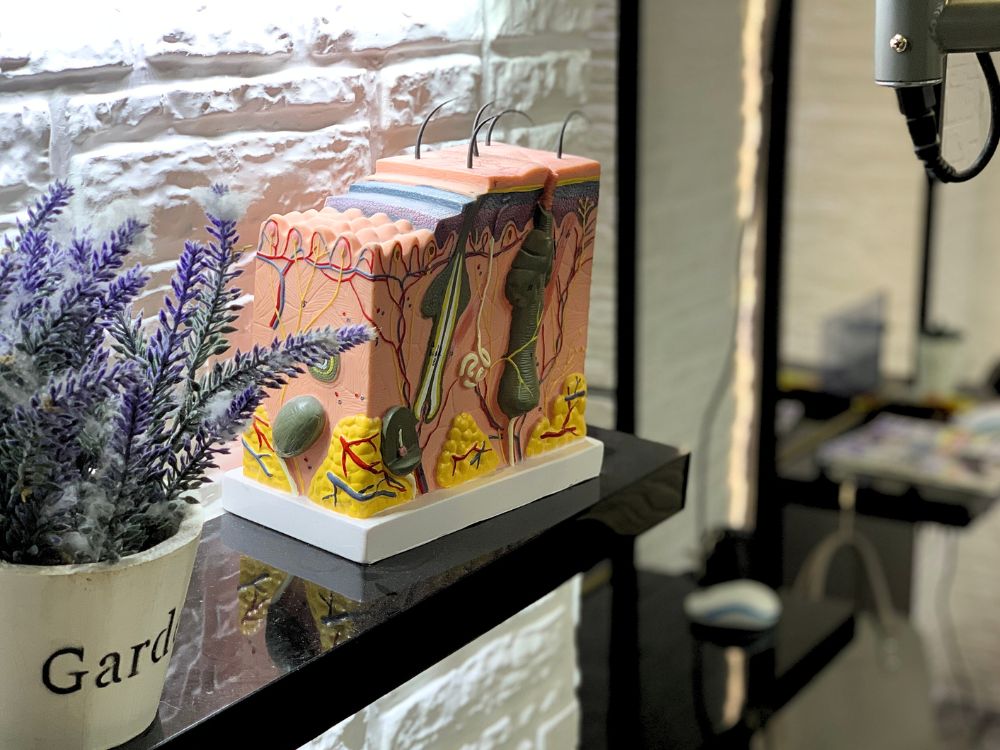
A key misconception is treating the scalp as “just hair.” In reality, your scalp is also skin with hair growing from it

It contains:
  • Hair follicles (pores)
  • Sebaceous glands (oil glands)
  • Skin microbiome* (good + bad microbes)

What is microbiome?

👉 The microbiome = all the bacteria, fungi, and other microbes that live in a specific area (like your scalp, skin, or gut)

Your scalp is home to a natural microbiome (a balanced ecosystem of bacteria and yeast that helps keep your scalp healthy). This includes microorganisms like Cutibacterium acnes and Malassezia, which normally live on your scalp without causing problems.

However, when this balance is disrupted, i.e. often due to excess oil, sweat, heat, humidity, or product buildup, certain microbes can overgrow. This overgrowth can irritate hair follicles, trigger inflammation, and lead to scalp pimples or acne.

Important difference from facial skin:
* The scalp has more oil glands, making it more prone to oil buildup
* It is usually covered by hair, creating a warmer, more humid environment
👉 Together, these factors increase the chances of scalp acne. Not because the skin is weaker, but because the conditions favor breakouts.

***

Is the Scalp More Sensitive Than Facial Skin?
Short answer: No.
✅ What is true:
  • The scalp is not inherently more sensitive than facial skin
  • It has a slightly thicker protective layer
Why it feels more sensitive:
The scalp becomes reactive due to its environment:
  • Higher sebum (oil) production
  • Heat and humidity
  • Sweat trapped under hair
  • Product buildup
  • Occlusion from hats, helmets, or hairstyles

👉 The scalp is not naturally more sensitive, but it is more prone to becoming irritated or inflamed.

***

What Causes Scalp Pimples?
1. Excess Oil Production
The scalp naturally produces sebum, but excess oil can:
  • Mix with dead skin cells
  • Clog hair follicles
  • Trigger inflammation
2. Microbial Imbalance
Scalp acne is linked to:
  • Bacterial overgrowth (Cutibacterium acnes)
  • Yeast imbalance (Malassezia)

These thrive in warm, oily, humid environments.

3. Product Buildup
Residue from hair products can accumulate over time:
  • Dry shampoo
  • Styling gels or waxes
  • Conditioner applied too close to the scalp

This acts like “blocked pores” on facial skin.

4. Sweat, Heat & Humidity
Sweat itself does NOT cause acne. However, when sweat is:
  • Trapped
  • Mixed with oil
  • Left unwashed

It increases the risk of clogged follicles and bacterial growth. This is especially common in hot, humid climates like Singapore.

5. Damp Scalp & Poor Drying Habits
This is often misunderstood.
✅ What is true:
  • Warm + moist environments promote microbial growth
  • Leaving hair damp for long periods can increase irritation risk
  • Covered damp hair (e.g., sleeping or tying it up) increases risk further
❌ What is false:
  • Water alone causes acne

It’s not “wet hair = acne,” but prolonged dampness + heat + occlusion = higher risk of scalp breakouts

6. Friction & Mechanical Stress
Repeated pressure or rubbing can trigger breakouts:
  • Helmets
  • Caps
  • Tight hairstyles

***

How to Prevent Scalp Acne
1. Cleanse Like You Care for Facial Skin
  • Choose a shampoo suited to your scalp type
  • Avoid both overwashing and underwashing
2. Always Dry Your Scalp Properly
One of the most overlooked but important steps.

Best practices:
  • Do not sleep with wet hair
  • Dry scalp after washing
  • Use low or cool heat if blow-drying
  • Avoid tying hair when damp
These reduces moisture buildup that can trigger irritation.
3. Use Targeted Active Ingredients
Look for clinically supported ingredients:
  • Salicylic acid → unclogs follicles
  • Ketoconazole → reduces yeast overgrowth
  • Zinc → helps control bacteria and inflammation
4. Prevent Product Buildup
  • Avoid applying conditioner to scalp
  • Limit heavy styling products
  • Use clarifying shampoo occasionally
5. Maintain Scalp Hygiene Habits
  • Wash after sweating
  • Change pillowcases regularly
  • Clean helmets and hats

***

Professional Scalp Treatments (Deeper Reset)
When scalp acne is persistent, professional treatments can help restore balance.
These treatments typically focus on:
  • Deep cleansing clogged follicles
  • Removing excess buildup
  • Rebalancing scalp oil levels
  • Calming inflammation
Detoxifying Herb Infusion
This treatment supports scalp health using:
  • Herbs extracts to soothe irritation
  • Detoxification techniques to remove buildup
  • Circulation support for healthier follicles

Think of it as a professional facial treatment, but for your scalp.

🚫 Common Myths About Scalp Acne
❌ “Wet hair causes scalp acne”

Not directly, only prolonged dampness in the wrong environment increases risk.

❌ “You just need to wash more”

Overwashing can strip natural oils and worsen imbalance.

❌ “Scalp care is just hair care”

Your scalp is living skin, it needs skincare-style attention.

***

Your Scalp Deserves Skin-Level Care

Scalp acne is not random, it develops due to a combination of:

  • Oil imbalance
  • Clogged follicles
  • Microbial activity
  • Environment and habits

The most important shift you can make is this: Treat your scalp like your skin, not just your hair.

With the right routine and awareness, scalp acne is highly manageable.

***

Book a Professional Scalp Assessment Today
If you’re experiencing:
  • Recurrent scalp pimples
  • Painful or inflamed bumps
  • Persistent oiliness or buildup
  • No improvement with home care
A professional scalp analysis can help identify the root cause and guide targeted treatment.
What you can expect:
  • Scalp condition analysis
  • Oil and sensitivity assessment
  • Follicle and buildup evaluation
  • Personalized treatment recommendation

Ready for a clearer, healthier scalp?

Book your scalp consultation today and take the first step toward long-term scalp health and confidence.

4 Easy Steps to Identify Your Scalp Type & Choose the Perfect Shampoo

So, how shall we start?

Healthy hair starts with a healthy scalp. But not all scalps are the same. Your scalp type whether oily, dry, normal, or sensitive, determines which shampoo, treatment, and care routine will work best for you. Knowing your scalp type and how ingredients interact with it is the first step toward balanced, nourished hair.

In this guide, we’ll cover:
Step 1: Identify Your Scalp Type

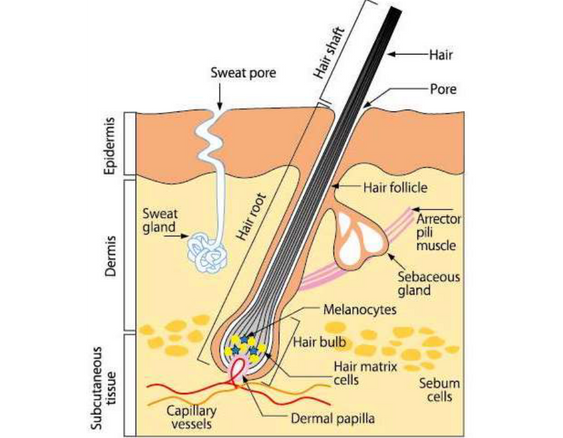
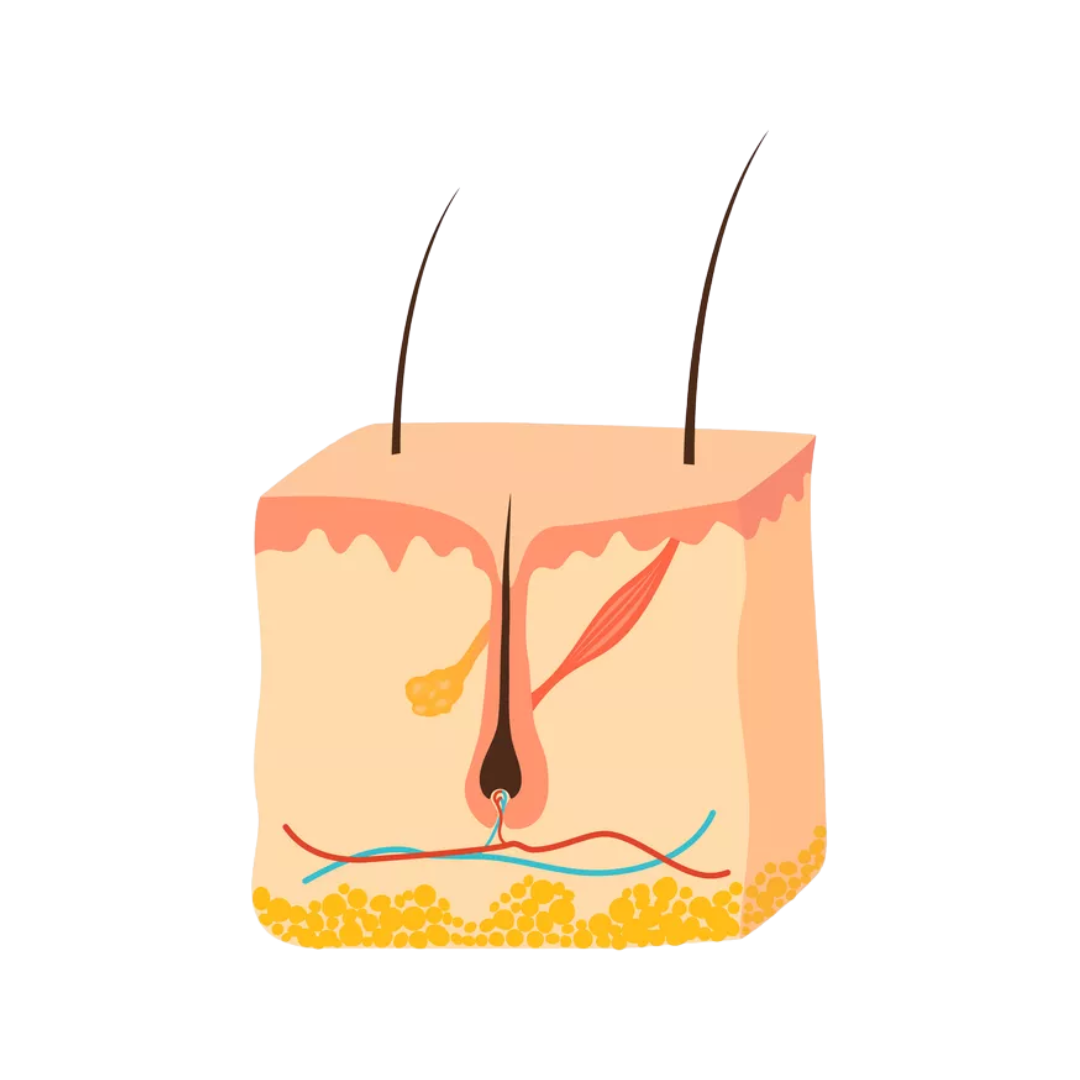
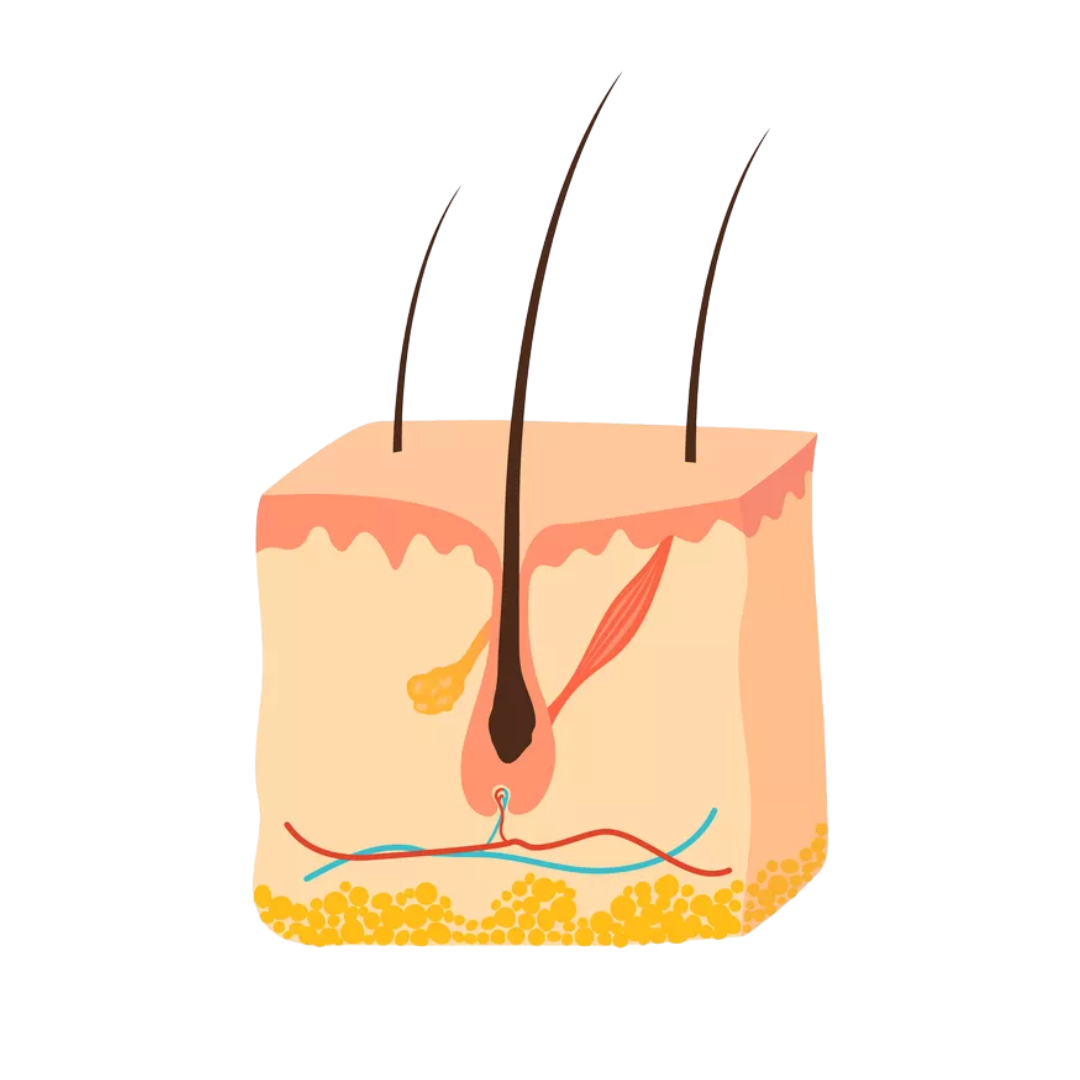
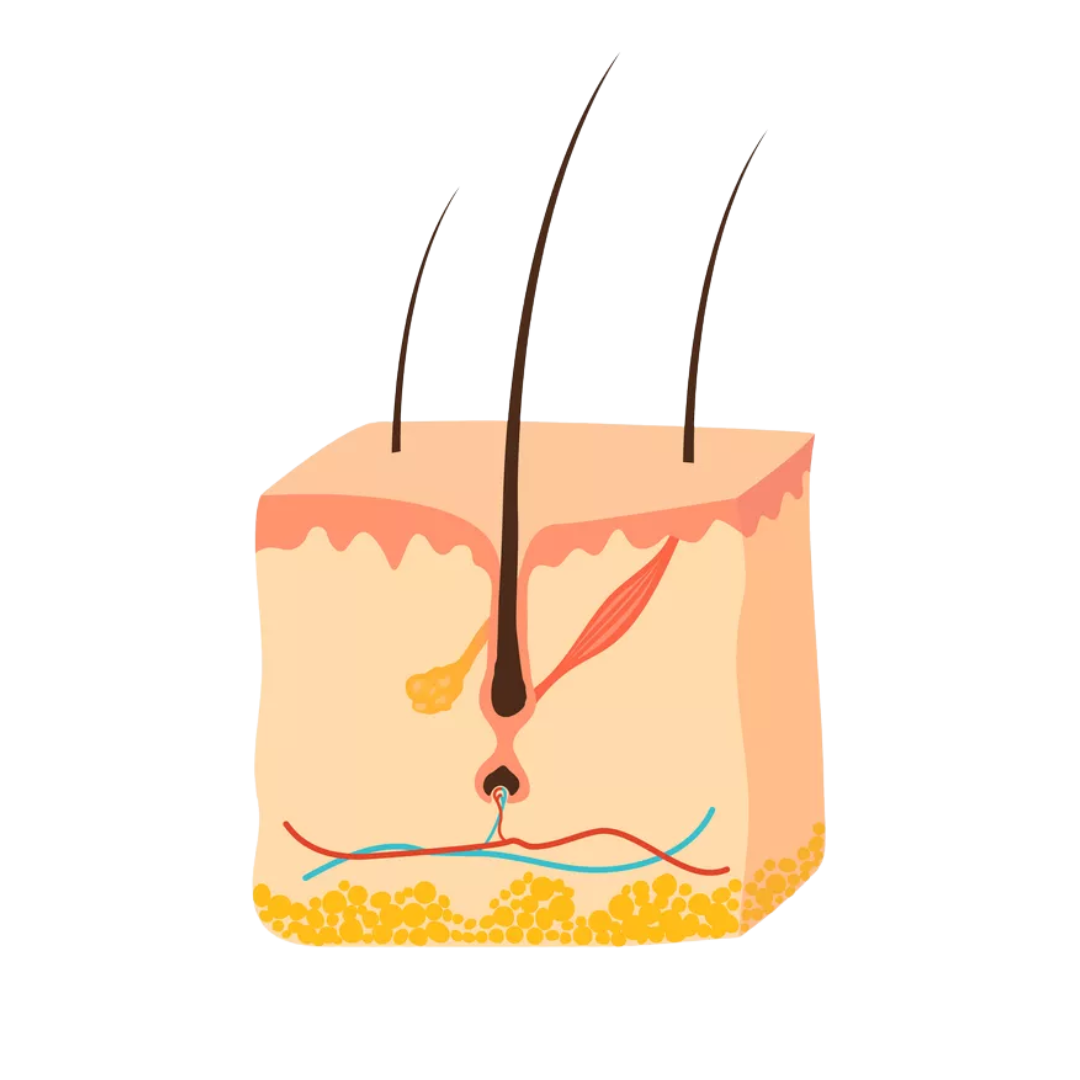
Each hair grows from a follicle, which has a tiny oil-producing gland called a sebaceous gland. This oil, called sebum, moisturizes your scalp, protects your hair, and helps guard against bacteria and fungi.

At the base of the follicle, new cells are continuously produced in the hair bulb. These new cells push older cells upward, where they harden into keratin and form the visible hair. Meanwhile, the scalp’s skin cells are also constantly renewing: as new cells form at the base of the skin, older ones die and rise to the surface, eventually shedding as dead skin. Sometimes dead skin cells mix with excess oil or product buildup, which can clog follicles and slow or disrupt healthy hair growth. The right shampoo helps keep your scalp balanced (not too oily, not too dry).

Oily Scalp (overactive sebaceous gland)
Scalp Type Problems - Oily Scalp

Common Signs
Feels greasy soon after washing, limp roots, product buildup

Recommended Shampoo
Deep-cleansing or balancing shampoos with clarifying surfactants

Dry Scalp (underactive sebaceous gland)
Scalp Type Problem - Dry Scalp

Common Signs
Tight, flaky, itchy

Recommended Shampoo
Moisturizing, sulfate-free shampoos with amino acids and oils

Normal Scalp (balanced sebaceous glands)
Normal Scalp Type

Common Signs
Feels clean and comfortable for 2–3 days after washing

Recommended Shampoo
Balanced, gentle formulas

Sensitive or Damaged Scalp
Scalp Type Problem - Dry Sensitive

Common Signs
Redness, irritation, tingling after wash

Recommended Shampoo
Mild, soothing shampoos with gentle surfactants and calming extracts

In humid climates, it’s common to have oily roots and dry ends. A balancing shampoo suited to your scalp type can cleanse effectively without stripping moisture. 🔗 You might be interested in 4 Common Scalp Problems in Singapore.

Step 2: How Surfactants Work

Surfactants are the cleansing agents in shampoo. They have two ends: one that attracts oil and dirt (hydrophobic) and one that attracts water (hydrophilic), which helps wash away grease, buildup, and impurities. The “charge” of a surfactant refers to the electric charge present on the water-loving (hydrophilic) end of the molecule.

Here are the main types used in modern, gentle formulations:

Anionic

Charge
Negative

Example
Sodium Laureth Sulfate (SLES SO₄⁻), TEA-Cocoyl Glutamate (–COO⁻)

Function
Effective cleansing and foaming

Gentleness
Medium to strong

Cationic

Charge
Positive

Example
Polyquaternium-10 (NR₄⁺)

Function
Conditions and smooths hair

Gentleness
Very gentle

Nonionic

Charge
No charge

Example
Cocamide MEA (–OH hydroxyl group)

Function
Adds mildness, stabilizes foam

Gentleness
Gentle

Amphoteric

Charge
Both

Example
Lauramidopropyl Betaine (COO⁻ and +NR₃⁺)

Function
Balances harshness, improves foam

Gentleness
Very gentle

The “charge” affects how the surfactant interacts with hair and skin. Negative charges clean well but can be harsher, positive charges condition hair, and neutral or amphoteric ones keep things gentle. Modern mild shampoos often mix mild anionic + amphoteric surfactants to give effective cleansing without irritating your scalp.
Step 3: SLS & SLES — Are They Good or Bad?
Sodium Lauryl Sulfate (SLS) and Sodium Laureth Sulfate (SLES) are common surfactants found in many shampoos and cleansers. Known for their strong foaming and cleansing abilities, they can be highly effective at removing oil and buildup.
Ingredient Function Pros Cons
Sodium Lauryl Sulfate (SLS)
Strong detergent and foaming agent
Deep cleans oily scalp
Can strip natural oils
Sodium Laureth Sulfate (SLES)
Gentler derivative of SLS
Smooth, effective foam
May still dry sensitive scalps

✔️ Ideal for oily scalps needing deep cleansing

✔️ Avoid for dry, sensitive, or color-treated hair

✔️ Although amino acid–based surfactants like TEA-Cocoyl Glutamate are anionic (with a negatively charged COO⁻ head), unlike traditional sulfate-based anionic surfactants such as SLES, they are much milder on skin and hair and do not contain harsh sulfates, making them gentle, sulfate-free alternatives for cleansing.

💡 Key point: ‘Anionic’ only describes the charge, not the harshness. The chemical structure of the head group and the tail determines how gentle or strong the surfactant is.

A Note for Sensitive Scalps
If your scalp type is sensitive, surfactants aren’t the only consideration, preservatives matter too.

Certain synthetic preservatives used in personal care, such as Methylchloroisothiazolinone (MCI), Methylisothiazolinone (MI), DMDM Hydantoin, Glycolactone, or Imidazolidinyl Urea, can occasionally cause irritation or allergic reactions in very sensitive individuals.

Our Miyaki shampoos range use MCI/MI in strictly regulated, low concentrations that meet international cosmetic safety standards, ensuring freshness and microbial protection.

⚠️ If you have a known sensitivity or allergy, we recommend performing a patch test before use or consulting your dermatologist for guidance. This transparent approach helps keep our formulas safe, effective, and suitable for most scalps, while acknowledging that extra-sensitive skin may need specialized care.

Step 4: Ingredient Analysis — Our Formulas for Every Scalp

Now that you understand your scalp type and the role of surfactants and preservatives, it’s time to see how our shampoos are formulated. Each shampoo is designed to support a specific scalp type, balancing health, moisture, and comfort while keeping hair nourished.

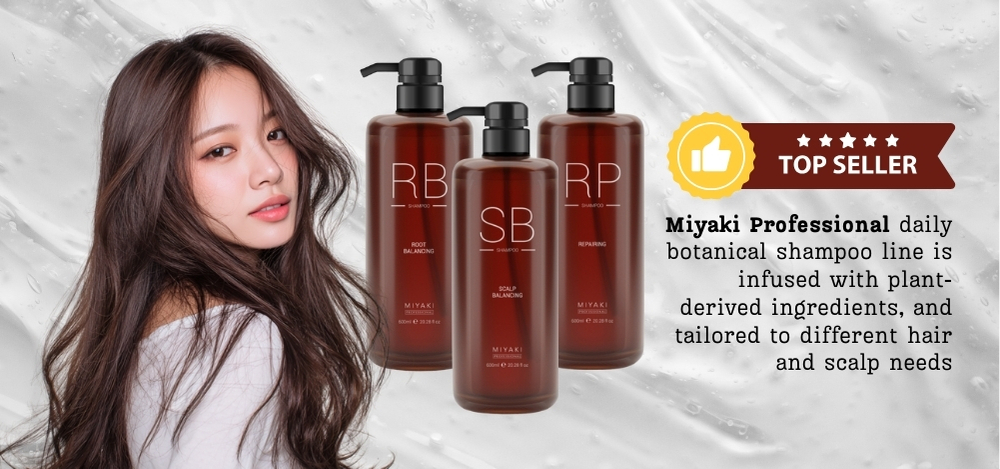
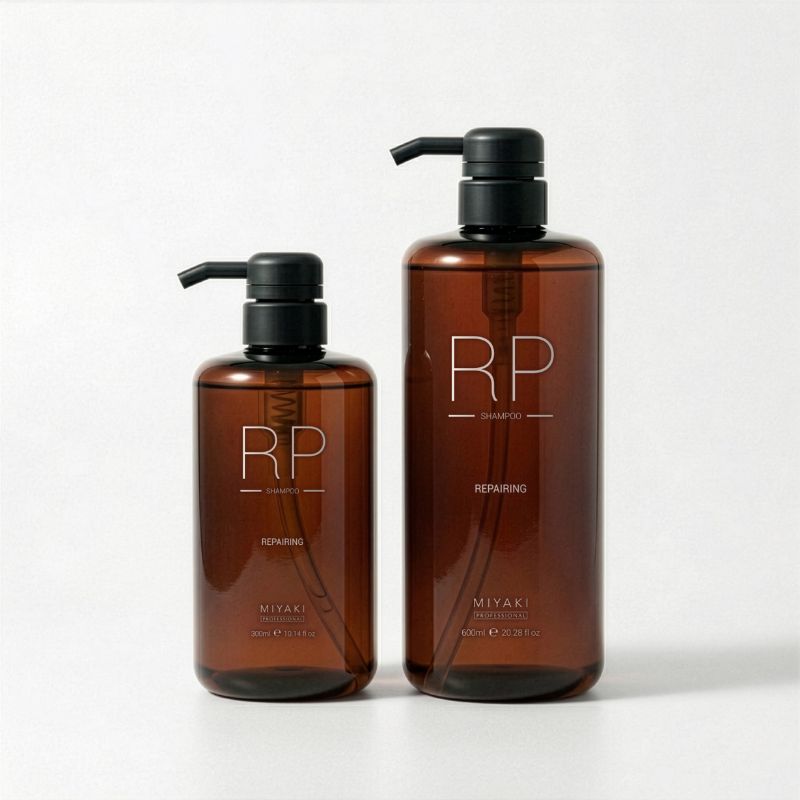
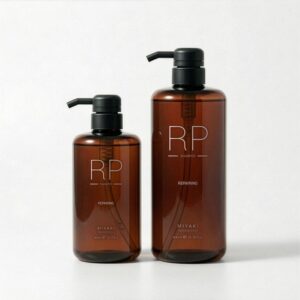
Shampoo Repairing Miyaki Professional
300/ 600ml
For dry or damaged hair

Select options This product has multiple variants. The options may be chosen on the product page

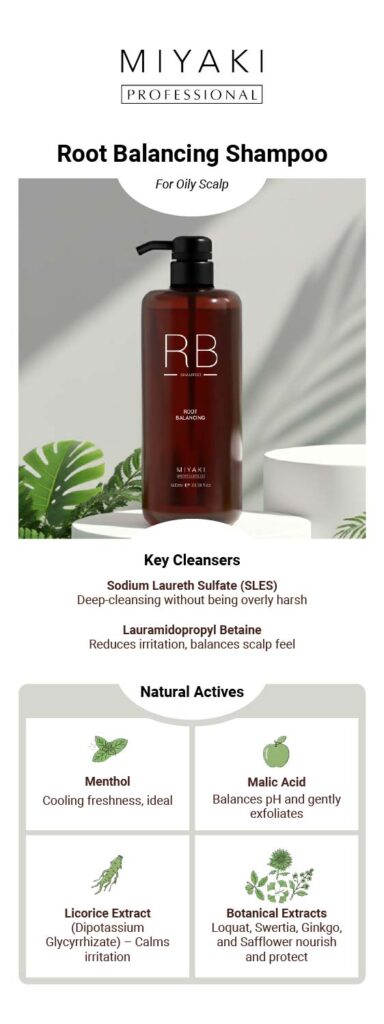
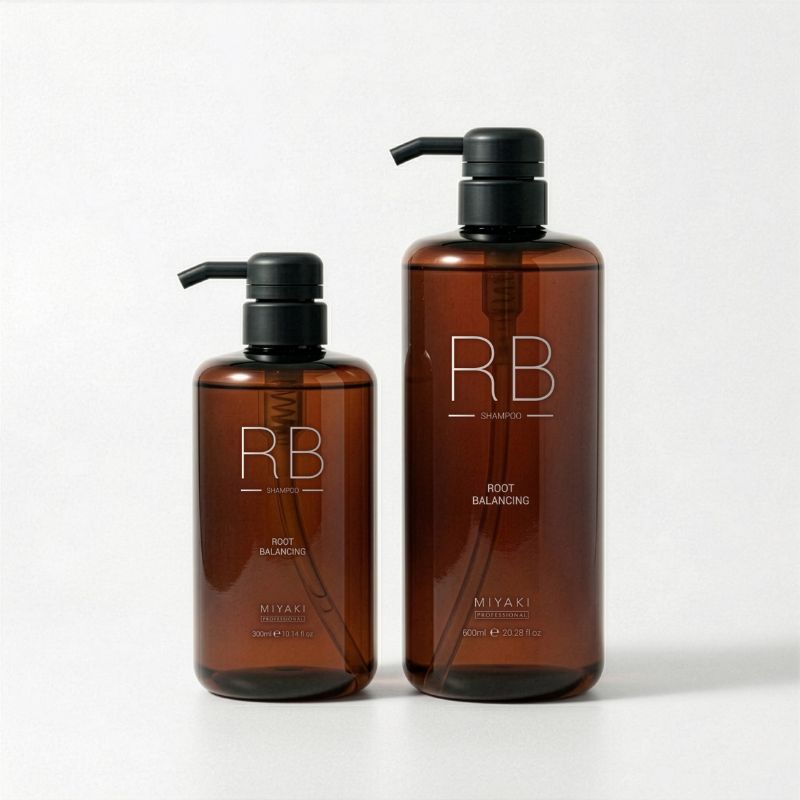
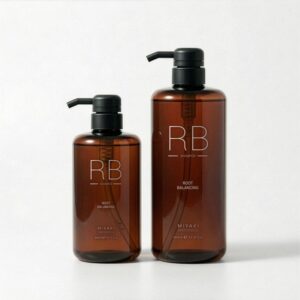
Shampoo Root Balancing Miyaki Professional
300/ 600ml
For Oily Scalp

Select options This product has multiple variants. The options may be chosen on the product page

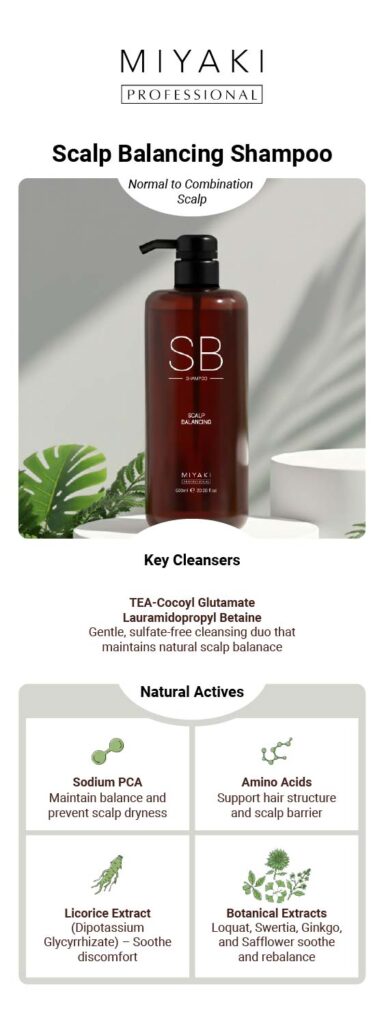
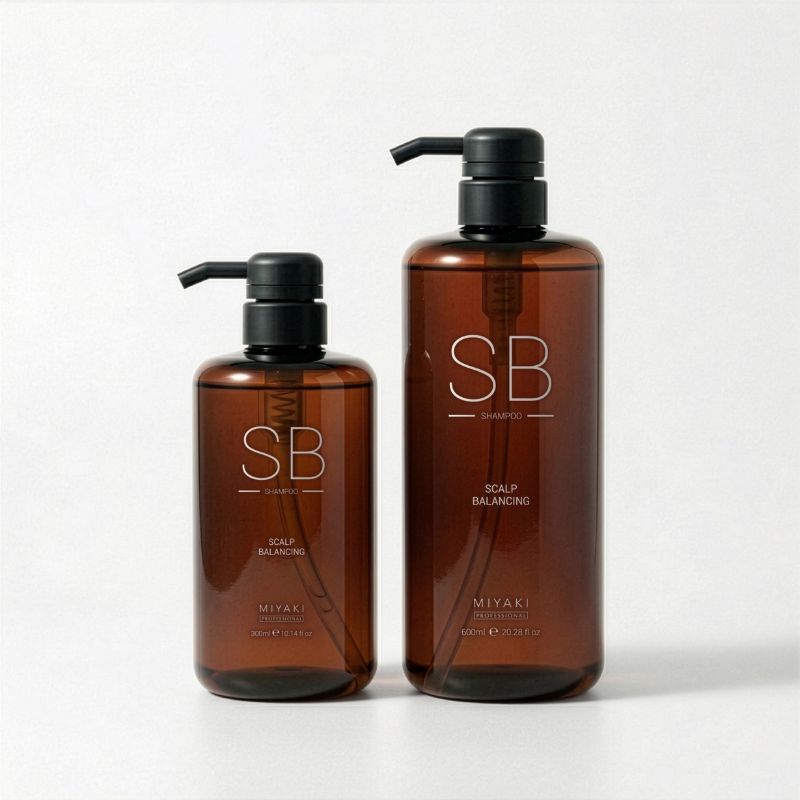
Scalp Balancing Miyaki Professional Shampoo
300/ 600ml
For Normal to Combination Scalp

Select options This product has multiple variants. The options may be chosen on the product page

All three Miyaki shampoos Root Balancing, Repairing, and Scalp Balancing contain key natural ingredients that help nourish, protect, and soothe the scalp and hair. These include Loquat Extract, Swertia Japonica Extract, Ginkgo Biloba Extract, Safflower Extract, and Licorice Extract (Dipotassium Glycyrrhizate).

Although these ingredients are common across all three formulas, the concentration and combination of each extract are tailored to address specific hair and scalp concerns. The Repairing Shampoo uses these extracts to restore moisture and strengthen damaged hair. The Root Balancing Shampoo focuses on rebalancing the scalp and controlling oil. The Scalp Balancing Shampoo helps hydrate and soothe irritation for a more comfortable scalp.

Shampoo Surfactants Key Function Ideal For Sulfate-Free
Repairing
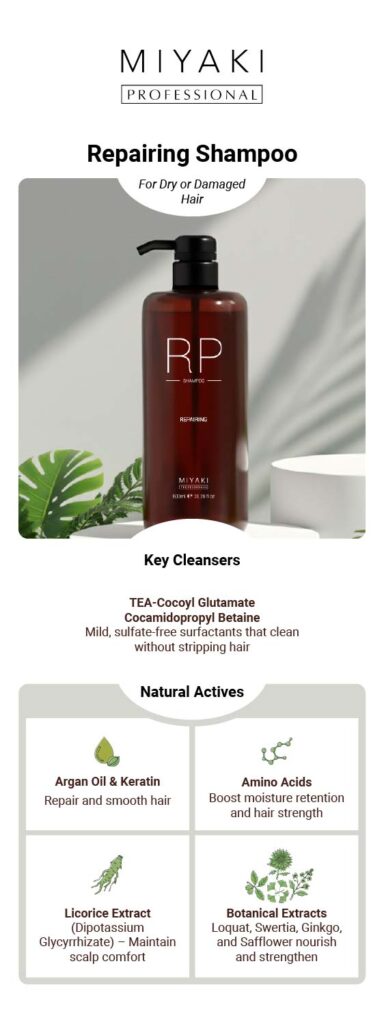
TEA-Cocoyl Glutamate, Cocamidopropyl Betaine
Repair, moisture
Dry/damaged hair
Root Balancing
Sodium Laureth Sulfate, Lauramidopropyl Betaine
Deep cleanse, refresh
Oily scalp
Scalp Balancing
TEA-Cocoyl Glutamate, Lauramidopropyl Betaine
Gentle balance
Normal/combination scalp
Healthy hair begins with a healthy scalp. I know this has been said many time, but that’s because it’s true and important. By understanding your scalp type and the role of surfactants and preservatives, you can choose a shampoo that supports and not stresses your natural balance.
Match Your Shampoo to Your Scalp Type

🌿 Oily scalp? Try our Root Balancing Shampoo for a refreshing cleanse.
🌾 Dry or damaged hair? Choose our Repairing Shampoo, rich in amino acids and oils.
🌸 Normal or slightly sensitive scalp? Our Scalp Balancing Shampoo keeps everything in harmony.

Each of our Miyaki shampoo is formulated with botanical extracts and modern natural surfactants, combining nature and science for scalp health that truly shows. Not sure which shampoo is right for your scalp type? Message us on Messenger and we’ll guide you! 🙂

How to Get Rid of a Smelly Scalp

Smelly Scalp

Smelly Scalp: Causes, Remedies, and How to Keep Your Hair Fresh

Smelly scalp is more common than you might think, and it can be caused by a variety of factors. Whether you’re dealing with excess oil, sweat, or even fungal issues, a smelly scalp can be embarrassing. Especially when you’re taking a group picture and have to squeeze into one frame, sometimes you end up bending down, and people can smell your scalp from above! But don’t worry! Once you know what causes the odor, you can easily address it (or at least start with somewhere simple). In this article, we’ll explore the common causes of a smelly scalp, ways to keep it fresh, and why your hair might still smell bad even after washing.

What Causes a Smelly Scalp?

Several factors can contribute to a smelly scalp. Understanding the root cause of your scalp’s odor is the first step in eliminating it.

1. Excess Oil Production

The sebaceous glands in your scalp produce sebum, a natural oil that keeps hair moisturized. However, when these glands produce too much oil, it can mix with sweat, bacteria, and dead skin cells. This creates the perfect environment for bacteria and fungi to thrive, leading not only to a strong, sour, or greasy smell but also to issues like oily scalp and even scalp acne. People with naturally oily hair are especially prone to these problems. (And sadly, I’m one of them!)

2. Sweat and Bacteria

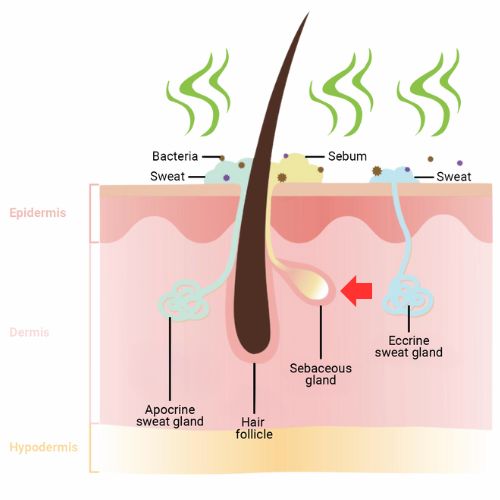
Your scalp has two main types of sweat glands:

  1. Eccrine sweat glands: Found all over the body, including the scalp, they produce a watery sweat mainly for temperature regulation. Even though eccrine sweat is mostly odorless, when it mixes with bacteria on the scalp, it can produce an unpleasant smell.

  2. Apocrine sweat glands: Concentrated around the hair follicles, these glands produce a thicker, milky sweat rich in proteins and lipids. When bacteria break down this sweat, it generates a stronger, characteristic body odor, which can contribute to a smelly scalp.

Both types of sweat can harbor bacteria, but eccrine sweat usually causes mild odor, whereas apocrine sweat tends to produce stronger smells due to its protein- and fat-rich composition.

3. Poor Scalp Hygiene

Neglecting to wash your hair regularly or not properly rinsing your scalp can lead to the buildup of oils, sweat, and product residue. This buildup is a major contributor to a smelly scalp.

4. Fungal Infections

A smelly scalp can also be the result of fungal overgrowth. Conditions like dandruff or seborrheic dermatitis are caused by yeast or fungi, which can lead to excessive oiliness, flaking, and, of course, a smelly scalp.

5. Diet and Food Choices

Certain foods, like spicy dishes or garlic, can make your body’s odor more pronounced, including the smell of your scalp. The way your body processes food and sweat can contribute to a smelly scalp.

6. Tight Hairstyles
Tight Hairstyle

Tight hairstyles, such as braids, buns, or ponytails, trap sweat and oil against your scalp. This lack of airflow can cause a buildup of bacteria, leading to an unpleasant odor on your scalp.

7. Hormonal Changes
Hormones Change

Hormonal fluctuations, whether from puberty, pregnancy, or menopause can lead to increased oil production on the scalp, which in turn can lead to a smelly scalp. Hormones play a key role in scalp health, and a hormonal imbalance can contribute to stronger odors.

8. Dehydration
Dry Scalp

When your scalp is dehydrated, it often overcompensates by producing more oil. This excess oil, when mixed with sweat and bacteria, can cause a smelly scalp.

Why Does Your Hair Smell Bad Even After Washing?

It’s frustrating when you’ve washed your hair thoroughly, but the smell won’t go away. There are a few reasons why your hair might still have a smelly scalp after washing:

1. Incomplete Rinsing

If shampoo or conditioner isn’t properly rinsed from your scalp, it can leave behind residue that combines with sweat and bacteria, causing a lingering smell.

2. Overuse of Styling Products

Excessive use of hairsprays, gels, or other styling products can lead to a buildup on your scalp. Even after washing, this buildup can trap bacteria and contribute to a smelly scalp.

3. Fungal or Bacterial Infections

Conditions like dandruff or seborrheic dermatitis can cause a persistent smelly scalp, even with regular washing. These conditions often require special medicated shampoos or treatments to eliminate the fungal or bacterial overgrowth. You might be interested to read: 4 Common Scalp Problems in Singapore

4. Damp Hair

I know sometimes for long-haired girlie like me, it’s such a hassle to dry your thick, long hair especially after a long day out when all you want to do is lie down on the bed. However, leaving your hair damp or wet for too long can promote bacterial and fungal growth on your scalp, leading to a musty odor. Hence, always make sure your hair is thoroughly dry after washing to prevent a smelly scalp.

5. Oily Scalp

If you have an oily scalp, even after washing, your scalp may continue to produce oil quickly, which mixes with sweat and bacteria, resulting in a smelly scalp that doesn’t stay fresh for long. (Difficult hor? Wash also cannot, don’t wash also cannot, so the solution is… WELL, read on!)

So... How to Keep Your Scalp Fresh

Keeping your scalp fresh and odor-free can start small! Here are the 6 simple practices to prevent and address a smelly scalp:

1. Regular Shampooing

Regular washing is essential to remove oils, dirt, and bacteria from your scalp. A smelly scalp can be controlled by using a gentle, sulfate-free shampoo that suits your hair type. For oily scalps, consider washing your hair more frequently, but avoid over-washing, as this can lead to dryness and trigger more oil production.

Shop Our Top-Pick Shampoos

Formulated for Every Hair and Scalp Concern!

Miyaki Professional Root Balancing
For Oily Hair

Miyaki Root Balancing Shampoo
Prevents excess oil production in the scalp to prevent oily roots and adds volume to make hair look fuller.

$40.00 – $68.00

Select options This product has multiple variants. The options may be chosen on the product page

Miyaki Professional Repairing Shampoo
For Dry & Damaged Hair

Miyaki Repairing Shampoo
Deeply hydrates and nourishes hair from root to tips to repair dry and damaged hair.

$40.00 – $68.00

Select options This product has multiple variants. The options may be chosen on the product page

Miyaki Professional Scalp Balancing Shampoo
For Normal/ Dry Scalp

Miyaki Scalp Balancing Shampoo
Balances overall scalp and hair environment to prevent dryness and frizz.

$40.00 – $68.00

Select options This product has multiple variants. The options may be chosen on the product page

2. Exfoliate with a Scalp Treatment

Exfoliating your scalp is an effective way to remove dead skin cells and prevent the buildup of oils that can lead to a smelly scalp. Professional scalp treatments or exfoliating scalp scrubs can help improve scalp health by clearing away buildup and promoting a fresh, clean scalp.

3. Professional Scalp Treatments

For persistent issues like dandruff or an oily scalp, visiting a professional is essential. They can recommend advanced scalp treatments that help balance oil production, eliminate bacteria or fungi, and restore a healthy, fresh-smelling scalp.

At De Arte Hair Studio, we don’t just style and cut hair, we offer a complete, one-stop service focused on both scalp and hair health. Our advanced scalp treatments are tailored to your specific needs, ensuring long-term results and a healthier foundation for hair growth.

What to Expect for Scalp Treatment
Scalp Consultation-01

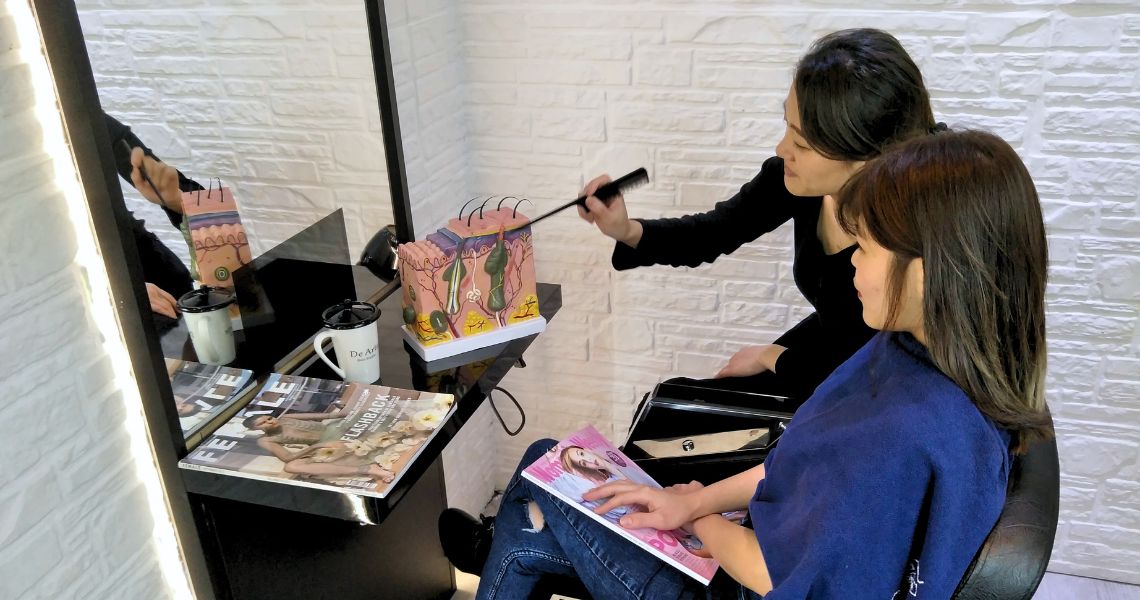
1. Consultation

A one-on-one session with our scalp specialist to understand your concerns, symptoms, lifestyle, and product history.

Scalp Consultation-02

2. Analysis

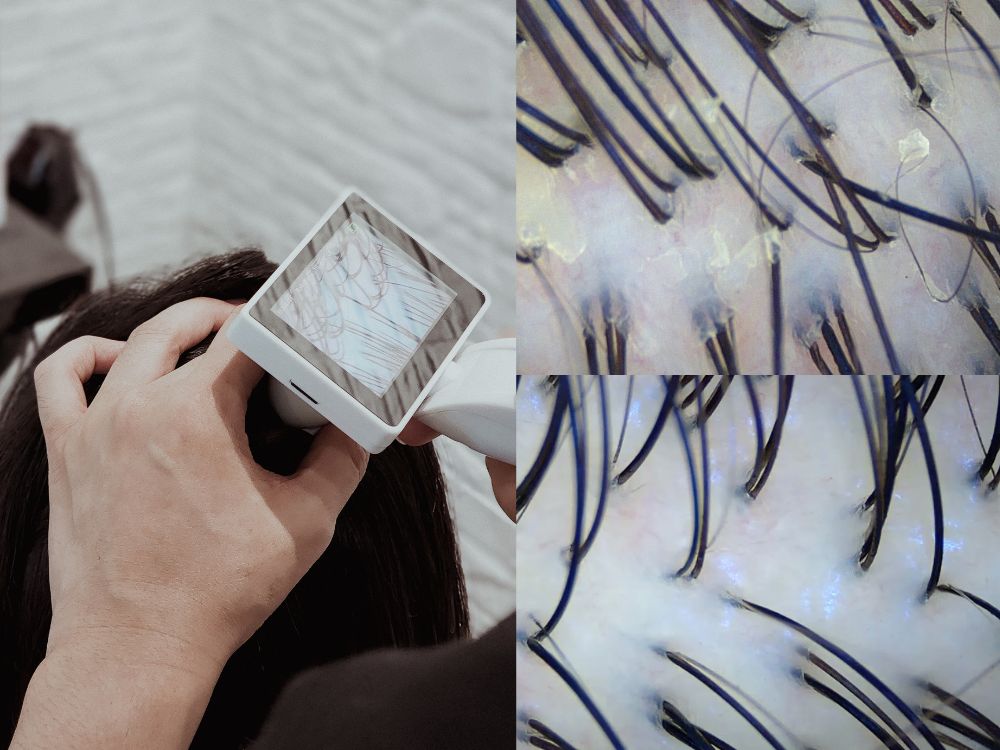
A detailed scalp analysis using professional tools and techniques to assess oil levels, dandruff presence, inflammation, clogged follicles, or fungal activity. This helps us accurately identify the root cause of your scalp issues.

Scalp Consultation-03

3. Treatment

Based on your diagnosis, we apply targeted professional treatments to detoxify, balance, and nourish the scalp, often incorporating exfoliation and deep cleansing solutions.

Scalp Consultation-04

4. Results

You’ll often notice immediate relief and visible improvements such as reduced flaking, less oiliness, or a calmer scalp. For more serious issues, the treatment’s full effect may take a few sessions, with improvements becoming clearer over time.

Scalp Consultation-05

5. Monitoring

To ensure long-term results, progress is monitored, and follow-up sessions are scheduled.

These follow-ups allow the stylist to adjust treatments as needed, ensuring optimal care and continued improvements for the client’s hair and scalp health.

4. Avoid Tight Hairstyles

Tight hairstyles prevent your scalp from breathing and can trap sweat and bacteria, which leads to a smelly scalp. Opt for looser styles, or allow your scalp to rest from tight braids and ponytails to reduce oil and sweat buildup.

5. Clean Your Hair Tools

Hairbrushes, combs, and hats can accumulate oils, dirt, and bacteria. These tools can transfer those contaminants back to your scalp, contributing to a smelly scalp. Regularly clean your hair tools to prevent buildup and bacteria transfer.

6. Maintain a Healthy Diet

A balanced diet can influence your scalp’s health and reduce the likelihood of a smelly scalp. Foods rich in omega-3 fatty acids, vitamins A and E, and antioxidants support scalp health. Drinking plenty of water also helps keep your scalp hydrated and fresh.

Book An Appointment

Dealing with a smelly scalp is common, but it can get worse if your routine isn’t right. Don’t wait! If the odor persists, you should consult a professional already.

With our professional help and a few scalp-care tips, you can enjoy a cleaner, healthier scalp and fresh-smelling hair. Book an appointment with us today to start your scalp care journey; and say BYEBYE to your smelly scalp!

Scalp Treatment: 7-in-1 Aroma Botanical for Hair Regrowth

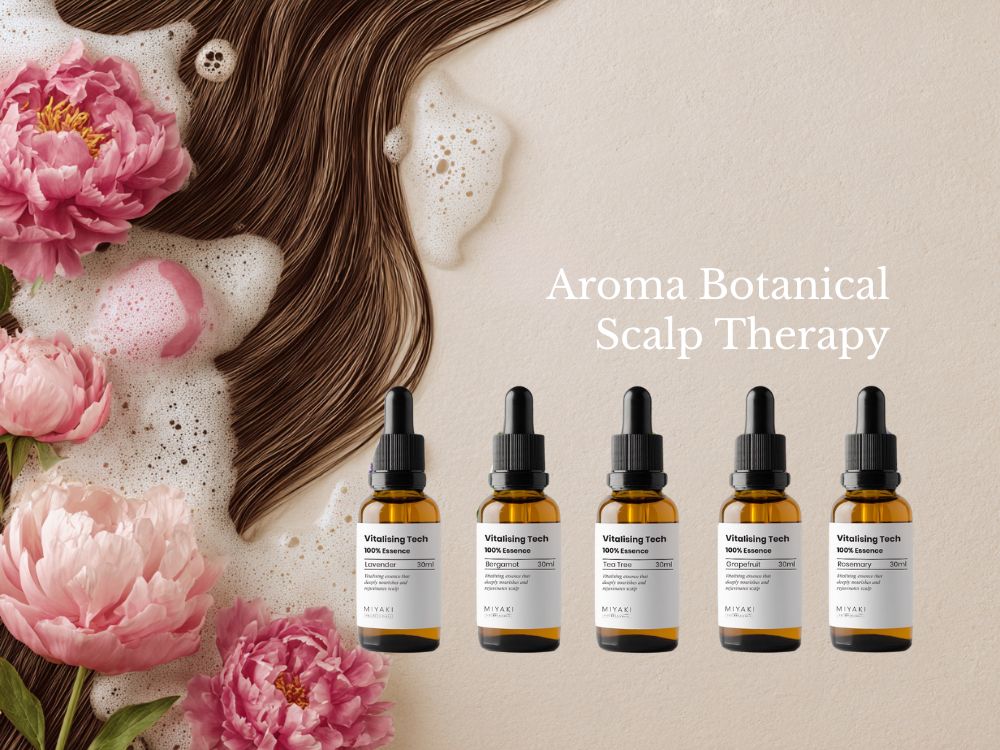
Aroma Botanical Scalp Therapy

Unlock the Power of Nature for Healthier Hair

Achieving healthy, beautiful hair starts with a healthy scalp. If you’re struggling with scalp issues like dandruff, itching, hair thinning, or dryness, it’s time to give your scalp the attention it deserves. Aroma Botanical Scalp Therapy is an innovative scalp treatment designed to rejuvenate, detoxify, and nourish your scalp, creating the ideal environment for stronger, more vibrant hair.

Common Scalp Concerns: Are You Facing These Issues?

Scalp Type Problem - Dry Scalp
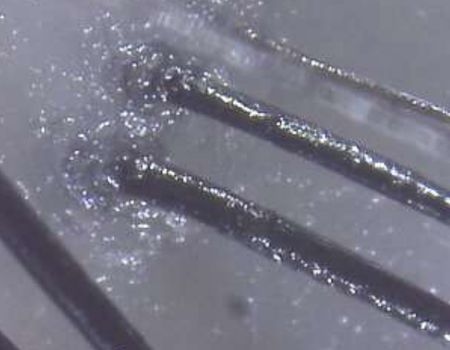
Oily dandruff
Scalp Type Problems - Oily Scalp
Scalp Type Problem - Dry Sensitive

Scalp problems are more common than you might think, affecting many people at some point. These issues can range from mild irritation to more severe hair loss, impacting both hair health and overall confidence. Common scalp concerns include:
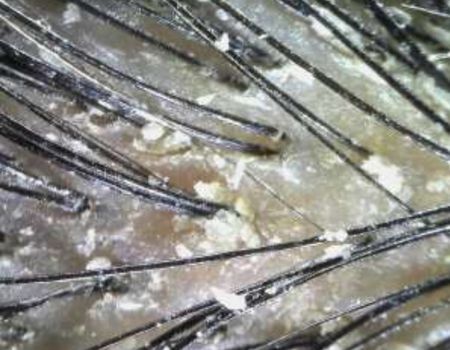
  • Dandruff: Flaky, dry scalp caused by factors like fungal infections or excessive skin shedding. Read more about dry scalp vs dandruff
  • Itchy Scalp: Itching may arise from dryness, allergic reactions to hair products, or oil imbalances.
  • Hair Thinning or Loss: A weakened scalp environment can cause hair follicles to deteriorate, leading to thinning or even hair loss.
  • Scalp Sensitivity: Redness, soreness, or irritation may result from harsh chemicals, improper care, or product buildup.

If you’ve dealt with any of these issues, you’re not alone. They can affect not only the look of your hair but also your self-confidence. The good news? With the right care and ingredients, you can improve both your scalp health and hair growth. Read more about common scalp problems
More Than Just Styling: We Do Scalp Treatments Too

While we take pride in our expert cuts and color, we understand that your scalp’s health is the true foundation of healthy hair growth. At De Arte Hair Studio, we’re deeply committed to your hair’s long-term vitality, which is why we focus on nurturing and restoring the health of your scalp. Your scalp is the root of healthy hair growth and we care about creating the best possible environment for your hair to grow strong, vibrant, and healthy.

We know that every scalp is unique, which is why we offer personalized treatments that address your specific concerns, whether it’s dryness, frizz, an itchy or flaky scalp, oily hair, or hair thinning. Your scalp’s well-being is at the heart of what we do, and we’re here to ensure it’s always in the best condition to support the beautiful hair you deserve.

To ensure we recommend the most effective treatments, we will conduct a detailed scalp analysis using advanced deep learning models to assess concerns such as hair loss, oil levels, and sensitivity. This helps us provide the most targeted treatment plan, specifically tailored to your individual needs.

Aroma Botanical Scalp Therapy: A Natural Solution

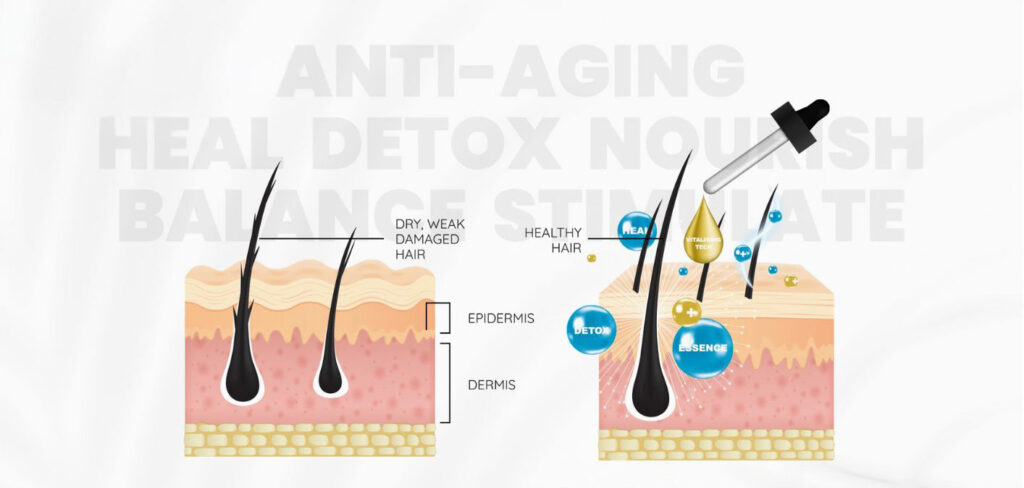
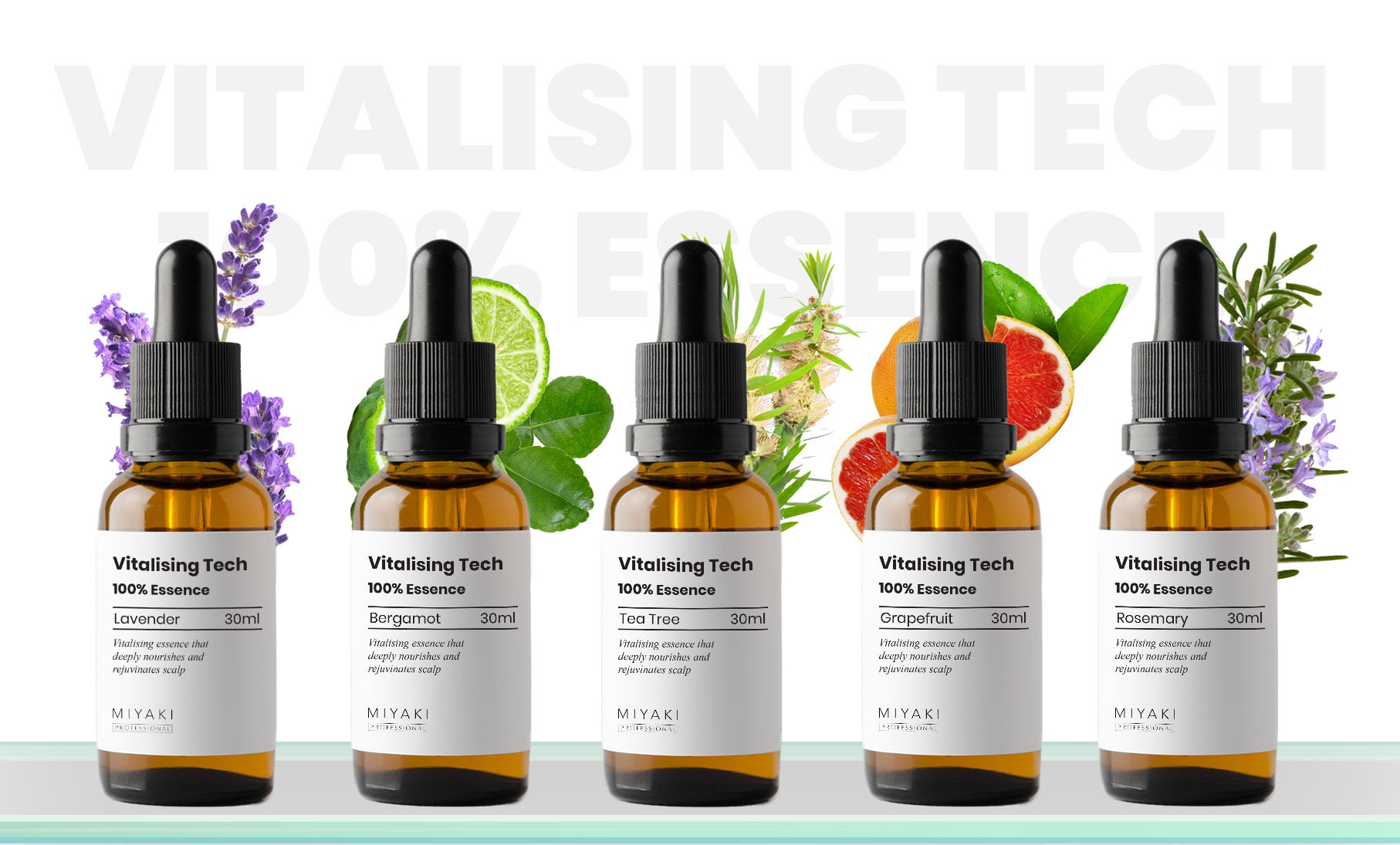
Aroma Botanical Scalp Therapy uses the power of nature to address your scalp concerns. This customized treatment uses Miyaki Vitalizing Tech 100% Essence and is infused with botanical extracts and essential oils to restore balance, nourish your scalp, and promote hair follicle health. Unlike traditional treatments that rely on harsh chemicals, Aroma Botanical utilizes pure, plant-based ingredients to cleanse, rejuvenate, and revitalize your scalp.

Scalp Therapy Vitalising Tech

The Power of Botanical Ingredients

  • Lavender: Contains anti-microbial properties that helps prevent bacteria and fungi from growing, and prevents itchy scalp and dandruff.
  • Bergamot: Rich in anti-bacterial and anti-inflammatory properties that facilitate wound healing and reduce inflammation due to common scalp problems, and promotes a healthy overall scalp environment.
  • Tea Tree: A powerhouse of soothing and healing properties that deeply cleanses the scalp from dead skin cells for a healthier scalp.
  • Grapefruit: Cleanses scalp and hair from debris and chemical build up that brings shine and luster back into hair.
    Rich in vitamins A and C that boost hair growth and healthy hair follicles.
  • Rosemary: Stimulates blood circulation in the scalp to prevent thinning hair and nourishes hair follicles to promote hair growth.

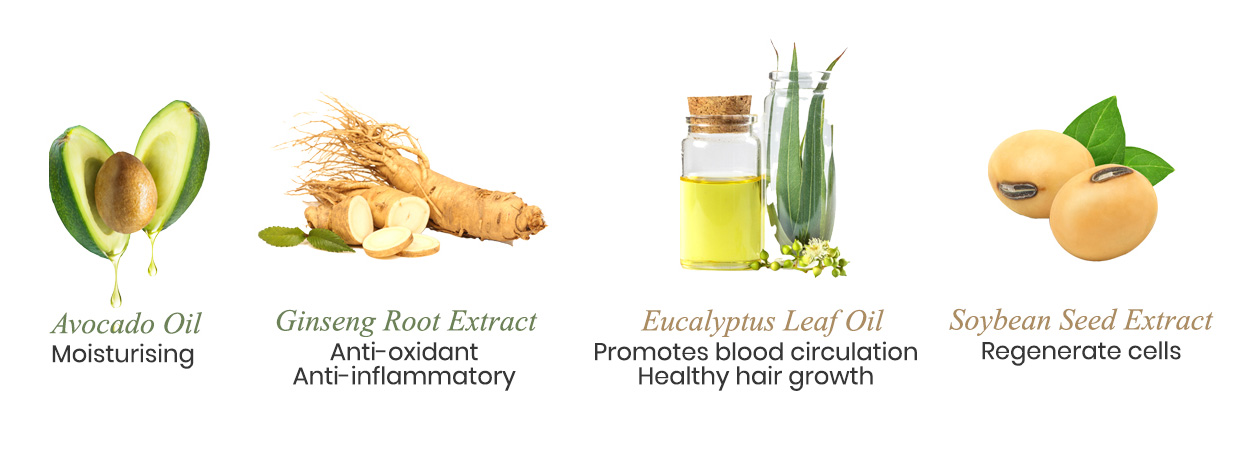
We also enhance the treatment with Miyaki Scalp Spa, featuring ingredients like:

  • Avocado Oil: Deeply moisturizes and nourishes the scalp.
  • Ginseng Root Extract: Soothes the scalp and calms inflammation with natural antioxidant support.
  • Eucalyptus Leaf Oil: Stimulates hair follicles and encourages growth.
  • Soybean Seed Extract: Regenerates scalp cells for a balanced scalp.

These botanical extracts, combined with cutting-edge technology, ensure your scalp receives the deep nourishment it needs for optimal hair growth.
Miyaki Scalp Spa

The 7-in-1 Hair Regrowth Treatment

Aroma Botanical’s 7-in-1 Hair Regrowth Treatment provides a comprehensive solution to scalp health, working together to cleanse, detoxify, and rejuvenate your scalp for maximum results. Each step is designed to create the perfect environment for your hair to grow strong and healthy:

Scalp Treatment Step Icon-01

1. Bubble Detox
Removes pollutants, free radicals, and chemical buildup from the scalp, ensuring a healthy base for hair growth.

Scalp Treatment Step Icon-02

2. Hair & Scalp Shampoo
Purifies the scalp at the roots, leaving it clean and refreshed.

Scalp Treatment Step Icon-03

3. Scalp Detox Mask
Unclogs pores and eliminates deeply seated impurities that may hinder hair growth.

Scalp Treatment Step Icon-04

4.  Scalp Toning Massage
Stimulates oxygenation and promotes healthy circulation, creating the ideal conditions for hair growth.

Scalp Treatment Step Icon-05

5.  High-Frequency Treatment
Kills bacteria and enhances scalp health while improving ingredient absorption.

Scalp Treatment Step Icon-06

6. Oxygen Essence Penetration
Deeply hydrates the scalp and promotes efficient absorption of nourishing ingredients.

Scalp Treatment Step Icon-07

7.  Bio Light Therapy
Boosts collagen production, strengthening hair follicles and encouraging healthy hair growth.

Who Should Try This Scalp Treatment?

If you’re dealing with scalp irritation, dryness, thinning hair, or other common issues, Aroma Botanical Scalp Therapy is the solution you’ve been looking for. Our unique blend of botanical extracts, combined with advanced technology, detoxifies, nourishes, and rejuvenates your scalp, creating a foundation for fuller, shinier hair.

Take the First Step Toward Healthier Hair

Ready to give your scalp the care it deserves? Aroma Botanical Scalp Therapy is here to help. Don’t let scalp issues hold you back from having the hair you’ve always wanted.

Experience the healing power of nature and restore balance to your scalp for healthier, more beautiful hair.

4 Common Scalp Problems in Singapore

4 Common Scalp Problems in Singapore and How to Fix Them

When it comes to maintaining healthy hair, many people focus solely on the products they use to style or treat their hair. But the truth is, a healthy scalp is just as, if not more but as important. Especially for individuals living in fast-paced, urban environments like Singapore, the challenges faced by your scalp can directly affect your hair’s health, appearance, and growth.

In this article, we’ll explore the 4 common scalp problems you may encounter, the effects they have on your hair, and how to address them for a healthier scalp and hair growth cycle, with a focus on those experiencing scalp concerns in the modern, often stressful world of their 20s and 30s in Singapore.

Understanding Scalp Problems: Causes and Effects on Hair

Scalp health is something that’s often overlooked, yet it’s fundamental to the health of your hair. In fact, a healthy scalp is the foundation for healthy hair growth. When the scalp is neglected or exposed to harmful factors (be it environmental stressors, poor diet, or even the wrong hair care routine), your hair follicles can become compromised, leading to conditions such as thinning hair, dryness, excessive oil, or dandruff.

In places like Singapore, where high humidity, pollution, and air conditioning are daily realities, the scalp faces unique challenges. The effects of these environmental factors can exacerbate scalp issues that, if not addressed, can lead to serious hair concerns later on.

4 Common Scalp Problems in Singapore

It’s easy to assume that scalp problems only affect people with visible dandruff or extreme hair loss.

However, many people experience scalp issues in more subtle forms, especially in the urban environments of Singapore. Regardless of your age, understanding the underlying causes of scalp discomfort and hair thinning is key to finding effective solutions.

1. Oily Scalp
Scalp Type Problems - Oily Scalp
Its Impact on Hair Health

If your scalp feels greasy soon after washing, or you find that your hair becomes limp and flat by midday, you may be dealing with an oily scalp. Oily scalps are especially common in humid climates like Singapore, where the excess moisture in the air can stimulate the sebaceous glands, causing them to overproduce sebum (oil).

While oil is necessary to protect the scalp and keep it moisturized, an overproduction can lead to clogged hair follicles. Over time, this can cause irritation, inflammation, and even hair thinning. In the worst-case scenario, it could disrupt the natural hair growth cycle, leaving hair looking dull, lifeless, and thin.

The added effect of pollution only worsens the situation. When pollutants in the air mix with sweat and sebum on your scalp, they can form a barrier that prevents hair follicles from getting the nutrients they need. The result? A potential increase in dandruff, hair thinning, and overall unhealthy hair.

2. Dry Scalp
Scalp Type Problem - Dry Scalp
When Your Scalp Doesn’t Get Enough Moisture

On the opposite end of the spectrum, some people experience a dry scalp. This condition can be particularly common for those who spend a lot of time indoors in air-conditioned environments. Air conditioning can strip moisture from the scalp, leaving it feeling tight, itchy, and flaky.

A dry scalp might seem like a minor inconvenience at first, but it can have long-term consequences if not managed. Dryness can lead to dandruff (a more severe version often referred to as seborrheic dermatitis), or it may weaken hair follicles, making it more difficult for your hair to grow healthily. The scalp, like the skin on your face, requires hydration to maintain its barrier function and prevent irritation. Without sufficient moisture, the scalp’s health can deteriorate quickly.

3. Sensitive Scalp
Scalp Type Problem - Dry Sensitive
The Silent Culprit of Hair Problems

In addition to the physical effects of weather and pollution, many individuals (especially those in their 30s) experience a sensitive scalp. Over time, your skin’s tolerance to hair treatments or environmental stressors may diminish, leading to a more sensitive, reactive scalp. Sensitive scalp conditions may manifest as redness, inflammation, and an increased feeling of discomfort after washing or using hair care products.

A sensitive scalp can often be exacerbated by the harsh chemicals found in certain shampoos, conditioners, and styling products. While your hair may look good in the short term, these chemicals can strip away natural oils and disrupt the delicate balance of your scalp, causing irritation. This can lead to a vicious cycle where the scalp becomes even more sensitive and prone to further issues.

4. Oily Dandruff
Oily dandruff
When Oil and Flakes Don’t Mix

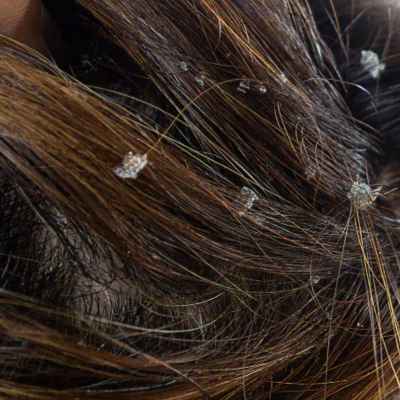
While dandruff is often thought of as a dry scalp issue, there is also a form of dandruff that is associated with oily scalps. Oily dandruff occurs when excess sebum mixes with dead skin cells, resulting in larger, greasier flakes. These flakes are not only unsightly but can also cause discomfort and irritation, often leading to a continuous cycle of scratching, which only worsens the condition.

This type of dandruff is more common in people with oily skin or a predisposition to seborrheic dermatitis, a condition that affects both the scalp and other oily areas of the body, like the face and chest. In Singapore’s climate, oily dandruff can be particularly persistent due to the heat and humidity, which keeps the scalp in a constant state of oil production.

What Causes Scalp Problems?

Understanding the root causes of scalp problems is the first step in addressing them effectively. Several factors, often working in combination, contribute to the development of scalp issues:

1. Environmental Factors

Humidity and Pollution: The high levels of humidity in Singapore encourage sebum production. Combined with urban air pollution, your scalp becomes a magnet for dirt, oil, and sweat, clogging pores and leading to inflammation.

Air-conditioning: While AC provides comfort, it also dries out your scalp, causing moisture imbalance and making it more prone to irritation.

2. Lifestyle Factors

Diet: A lack of essential nutrients, including vitamins and fatty acids, can make your scalp more susceptible to problems. A diet lacking in hydration and nutrients can leave your scalp dry and irritated.

Stress: The pressures of modern work-life balance, family commitments, and personal responsibilities can lead to heightened stress levels. Stress hormones, such as cortisol, can disrupt the scalp’s natural balance, leading to hair loss or skin sensitivity.

3. Hair Care Habits

Overuse of Hair Products: Constantly using styling gels, sprays, or other hair products with harsh chemicals can irritate the scalp and leave it vulnerable to dryness, itchiness, and other scalp conditions.

Improper Washing Routines: Overwashing or not washing your scalp enough can lead to either excess oil buildup or dryness. Finding a balanced hair care routine is essential for maintaining a healthy scalp.

4. Hormonal Changes

As you age, hormonal fluctuations can lead to changes in how your scalp behaves. Whether due to stress, pregnancy, or menopause, hormonal shifts can increase oil production, decrease moisture, or make the scalp more sensitive.

What Happens to the Follicle & Hair Growth Cycle When Disrupted?

Hair Growth

Scalp and Skin Structure Visualisation

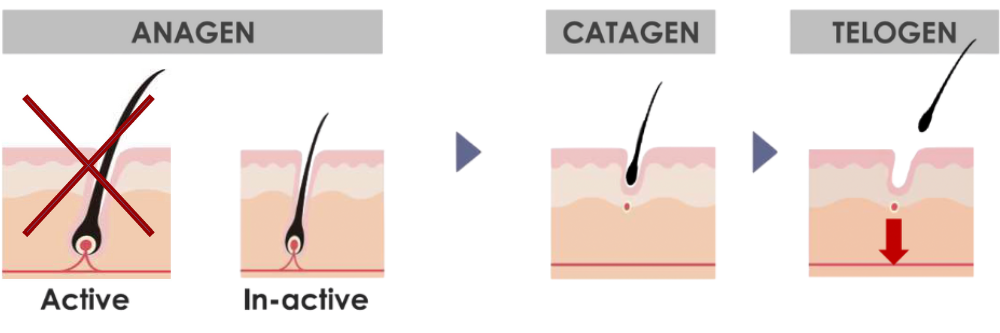
The hair growth cycle consists of three key phases: anagen (growth), catagen (transitional), and telogen (resting). Under normal conditions, hair grows for 2-7 years in the anagen phase before shedding and being replaced by new hair. However, when scalp issues (eg. excess oil, dryness, or inflammation) affect the follicles, this cycle can be disrupted, causing hair to behave differently. Here’s how:

Hair Grows Out Thinner due to Low FGF7 Activity

When FGF7 activity is low, hair follicles are less able to produce thick, healthy hair. FGF7 plays a crucial role in the anagen phase (growth phase) by signaling the dermal papilla to promote hair production. Without enough FGF7, the follicle’s growth is slowed, and the hair that grows is often thinner and weaker.

During the catagen phase, the dermal papilla naturally detaches from the follicle, and this detachment is even more pronounced when FGF7 activity is low. In addition, the dermal papilla does not anchor back to the deepest layer of the skin, where the capillaries are located, during this phase. This makes it harder for the follicle to receive vital nutrients and oxygen, further slowing down hair growth.

As a result, the follicle receives fewer growth signals and nutrients, causing hair to grow out thinner and leading to increased shedding. This disruption in the hair growth cycle, with weaker hair production and less efficient nourishment, can contribute to visible hair thinning and hair loss over time.

Shortened Lifespan of Hair

In a normal hair cycle, each hair strand goes through approximately 25 cycles of growth before naturally shedding. However, when the dermal papilla loses its ability to properly anchor to the scalp’s deepest layer, the hair growth phase shortens. As a result, hair enters the resting phase prematurely and the lifespan of each hair strand is significantly reduced. Normally, hair should last between 2 to 7 years, but in a compromised cycle, this could be reduced to as little as a few months.

Follicles Start to Die Off
Slow cells regeneration

The most severe consequence of a disrupted growth cycle is follicle atrophy. As your follicles undergo repeated cycles of stress, some may start to die off entirely. A healthy scalp typically has around 100,000 hair follicles, each going through their own individual cycles. However, when the follicles become damaged, you might see a reduction in the number of active follicles, perhaps dropping from 100,000 to 80,000, and even further to 40,000 in more advanced stages. This results in significant hair thinning and bald spots, particularly around the crown.

Once the follicles have regressed to this extent, nothing can fully revive them. This is why early intervention is critical to prevent long-term hair loss. If left untreated, the crown area may become shiny and bald, and regeneration becomes nearly impossible.

Hair Growth Becomes Dormant
Hair thinning

As the follicles face long-term stress from factors like poor blood circulation, hormone fluctuations, or constant scalp irritation, hair follicles can enter the dormant phase. This phase can last anywhere from 3 months to several years, depending on the severity of the disruption. During this time, hair growth slows significantly or stops altogether. As a result, hair thinning or shedding becomes more noticeable, particularly in areas where the follicles are weak or inactive.

For a more in-depth explanation of the hair growth cycle, read our detailed article on The Science of Hair Growth and Why You Should Care.

Solutions to Common Scalp Problems

Now that we’ve discussed common scalp problems, it’s time to explore the solutions that can help restore balance and ensure long-term scalp health.

For those experiencing an oily scalp, a gentle shampoo with salicylic acid or tea tree oil can help regulate oil production without stripping away too much moisture. Regular scalp exfoliation can also help remove buildup and prevent clogged pores.

On the other hand, if you’re dealing with a dry scalp, look for shampoos with hydrating ingredients like aloe vera or hyaluronic acid. Incorporating scalp oils such as coconut or argan oil into your routine can replenish moisture and restore balance.

For those with a sensitive scalp, choose hypoallergenic, fragrance-free products, and avoid any harsh chemicals or treatments. Calming ingredients like chamomile and lavender can help reduce inflammation and soothe the skin.

If you’re struggling with oily dandruff, try an anti-fungal shampoo containing zinc pyrithione or ketoconazole to address both the oil buildup and the flakes. Regular washing and treatment can help keep dandruff in check.

Overall Hair Growth Solutions: Restoring the Cycle

Restoring healthy hair growth involves addressing the root causes of scalp issues. Hair follicles thrive on a balanced, healthy scalp, where blood flow and nutrients can reach them effectively. Here are some additional ways to optimize your hair growth cycle:

Stimulate Follicle Health

To enhance hair growth, increase the activity of the dermal papilla in your hair follicles. The FGF7 (Fibroblast Growth Factor 7) helps stimulate healthy cell proliferation, leading to stronger and thicker hair. There are treatments that can help enhance this factor, including low-level laser therapy (LLLT) and scalp micropigmentation.

Promote Blood Circulation

A well-circulated scalp is crucial for nutrient delivery to the follicles. Massaging your scalp, using a derma roller, or investing in scalp stimulation tools can encourage better blood flow.

Nutritional Support for Hair Growth

Hair health isn’t just about what you put on your scalp, it’s also about what you nourish your body with. Ensure you’re consuming a balanced diet rich in vitamins and minerals like vitamin D, biotin, zinc, and omega-3 fatty acids to support the growth of healthy hair from the inside out.

Final Thoughts~

Taking care of your scalp is just as important as taking care of your skin and health. With the right approach and the right products, you can overcome common scalp issues and create an environment that encourages healthy hair growth. Whether you’re navigating the stresses of a busy career, adjusting to environmental changes in Singapore, or dealing with the challenges.

Book An Appointment

Book your FREE consultation today and get personalized advice just for you!

Dry Scalp vs. Dandruff: What Your Itchy Scalp Is Really Telling You

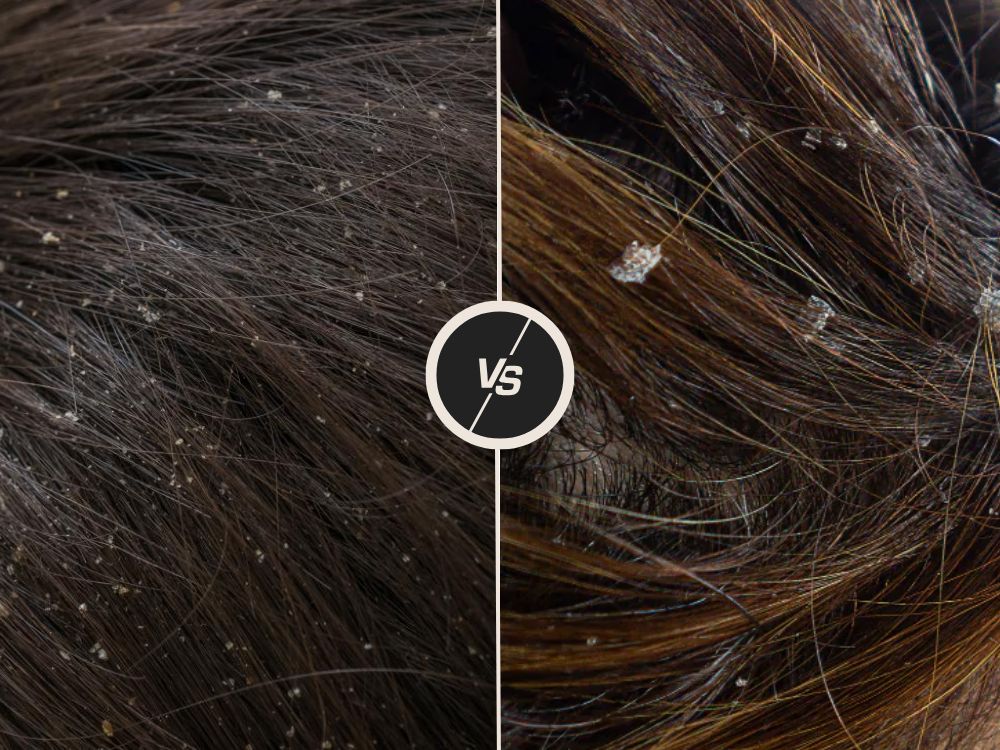
Dandruff VS Dry Scalp

If you’ve ever noticed flakes on your shoulders or experienced an itchy scalp, you might have wondered: Is it dry scalp or dandruff? While they share similar symptoms, their causes and treatments differ. Understanding these differences is important for effective care.

Dry Scalp

What Is Dry Scalp?

A dry scalp occurs when the skin lacks sufficient moisture. This can lead to irritation and flaking.

Common Symptoms
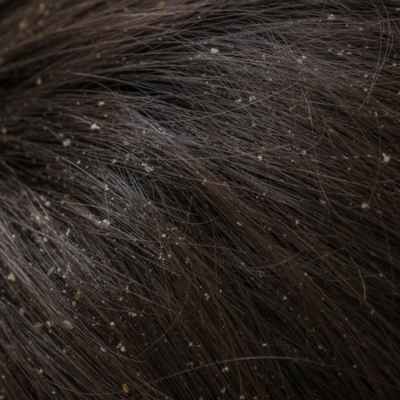
Small, dry, white flakes
Tightness or itchiness on the scalp
Flakes that fall off easily

Causes
Cold, dry air
Excessive washing or use of harsh hair products
Skin conditions like eczema
Aging, which reduces natural oil production

Dandruff

What Is Dandruff?

Dandruff is a common scalp condition caused by an overgrowth of a yeast-like fungus called Malassezia. This leads to increased skin cell turnover and flaking.

Common Symptoms
Large, oily, yellow or white flakes
Persistent itchiness
Red, irritated scalp

Causes
Overgrowth of Malassezia fungus
Oily scalp conditions
Sensitivity to hair care products
Skin conditions like seborrheic dermatitis

Dry Scalp vs. Dandruff: Key Differences

Sympton Area Dry Scalp Dandruff
Flake Type
Small, dry, white flakes
Large, oily, yellow or white flakes
Scalp Condition
Dry, tight, possibly itchy
Oily, red, and itchy
Causes
Lack of moisture, harsh products
Fungal overgrowth, excess oil

Environmental Factors Affecting Scalp Health

Living in Singapore’s tropical environment means dealing with high humidity, frequent rain, and intense sun, all of which can impact your scalp health. Here’s how:

High Humidity and Sweat

Singapore's consistently high humidity levels, often around 80% or more, lead to increased sweat and oil production on the scalp. This excess moisture can mix with sebum and dead skin cells, creating an environment conducive to the growth of bacteria and fungi, potentially leading to scalp irritation and dandruff.

Overwashing/ Product Buildup

To combat the greasy feeling from humidity, many people wash their hair more frequently. However, overwashing can strip the scalp of its natural oils, causing it to produce even more oil to compensate. Additionally, the use of heavy hair products can lead to buildup, clogging hair follicles and exacerbating scalp issues.

Sun Exposure

Prolonged exposure to intense sun can damage the scalp's skin, leading to dryness and irritation.

UV rays can also weaken hair strands, making them more susceptible to breakage.

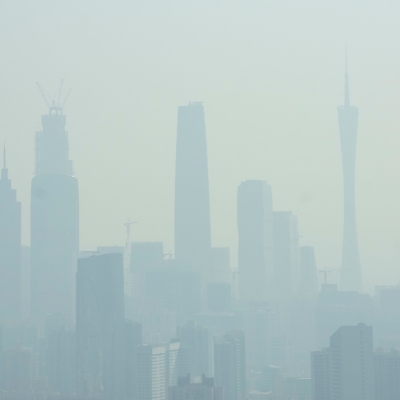
Air Pollution and Haze

Singapore occasionally experiences haze due to transboundary air pollution.

The fine particulate matter in the air can settle on the scalp, leading to clogged pores and inflammation, which may contribute to hair thinning and loss.

Other Everyday Factors That Affect Scalp Health

Even if the weather’s perfect, your scalp might still react to things you don’t usually think about:

Stress

Emotional stress can trigger hormone changes that affect oil production and scalp sensitivity (leading to flare-ups of both dry scalp and dandruff).

Harsh Hair Products

Shampoos with sulfates, alcohol, or heavy fragrances can strip moisture or irritate your scalp, especially if used long-term.

Tight Hairstyles

Wearing tight ponytails, hats, or helmets (common for riders or athletes in Singapore) can trap sweat and increase friction, leading to buildup and inflammation.

Poor Diet

Lack of essential nutrients like omega-3s, vitamin B, and zinc can compromise scalp health, slow healing, and worsen conditions like dryness or dandruff.

When you combine Singapore’s humid climate with everyday stressors like these, it’s no surprise that many people experience early signs of scalp imbalance (like mild itching or light flaking) even if the problem isn’t serious… yet.

Preventive Tips for a Healthy Scalp

Noticing a bit of itchiness or flaking? If your scalp issue is still in the early stages (not too serious yet), these simple steps can help you manage and improve your scalp health before it gets worse

Dry Scalp / Dandruff

Scalp types can vary greatly, and what works well for one person might not work for another. Trying out products without guidance can sometimes make things worse. Getting professional advice can save you time, money, and frustration in the long run.

Experience Comprehensive Scalp Care

At De Arte Hair Studio, we don’t just offer hair treatment, we provide comprehensive scalp care (eg. Aroma Botanical and Detoxifying Herb Infusion) too! Our scalp treatments include a FREE scalp analysis to identify your specific needs and a relaxing head massage to stimulate blood flow and promote relaxation. Experience the difference that targeted scalp care can make. Book an appointment today!

The Science of Hair Growth and Why You Should Care

The Science of Hair Growth Cover
Hair is more than just a beauty statement.

It’s a reflection of your overall health. Whether you’re trying to grow out your hair, prevent hair thinning, or simply maintain strong and vibrant locks, understanding the science of hair growth is key.

At De Arte Hair Salon, we believe that healthy hair starts at the roots, and with the right care, you can enhance your hair’s growth potential. In this article, we’ll explore the hair growth cycle, factors that influence growth, and why professional hair care services can make all the difference.

The Science Behind Hair Growth

Hair growth isn’t random, it follows a structured biological cycle that consists of three key phases. Each hair follicle goes through its own independent cycle of growth, rest, and renewal. This is why you’re constantly shedding some hairs while others are actively growing. Here’s the breakdown:

1. Anagen Phase 生长期
(Growth Phase)

The anagen phase is the longest stage of the hair growth cycle, lasting anywhere from 2 to 7 years. During this phase, hair follicles actively produce new hair cells, resulting in hair growing at a rate of approximately ½ inch per month. Around 85–90% of the hair on your scalp is in this active growth phase at any given time.

Hair Growth Stage 2 Catagen

2. Catagen Phase 退化期
(Transition Phase)

The catagen phase lasts about 2–3 weeks. During this time, hair stops growing, and the follicle begins to shrink.

This phase serves as a transition, preparing the hair for the next phase in the growth cycle.

Haie Growth Stage 3 Telogen

3. Telogen Phase 休止期
(Resting & Shedding Phase)

The telogen phase lasts about 3–4 months, during which old hair sheds, and new hair begins to grow underneath.

Typically, around 10-15% of your hair is in the telogen phase at any given time. During this phase, it is normal to shed about 50–100 hairs per day as the hair cycle progresses.

Normally, after the telogen (shedding) phase, the hair follicle starts a new anagen (growth) phase and produces a fresh hair. This cycle keeps repeating so your hair continuously renews.

However, sometimes hair follicles can get “stuck” in the telogen phase or fail to properly restart the anagen phase. When this happens:

  • The follicle remains inactive longer than usual.
  • No new hair grows from that follicle.
  • Over time, this leads to thinning and visible hair loss.

This can happen due to factors like genetics, hormonal imbalances (like high DHT), chronic stress, illness, or aging. So, while most hairs naturally cycle through all phases, some follicles may stop cycling properly and stay in telogen or even become dormant.

In short, the hair growth cycle is ongoing, but its effectiveness can change over time. A healthy hair cycle maintains a balance, with most hairs growing while some are resting or shedding at any given time.

Fun Fact: Have you ever wondered if shaving your hair makes it grow back thicker or faster?

Well, turns out, shaving all your hair at the same time doesn’t reset or synchronize the hair growth cycle of your follicles! Whether you shave or not, each hair follicle follows its own unique timeline, some are growing, some are resting, and others are shedding. So, shaving just gives you a fresh start on the surface, but the follicles beneath the skin continue with their natural cycle. The hair might feel coarser or appear thicker because shaving cuts the hair at a blunt edge, but it won’t change how fast or thick it grows.

How much hair do we have?

  • Hair Growth Rate: Hair typically grows about 0.9 to 1.2 centimeters per month, depending on factors like age, health, and genetics.
  • Number of Strands: The average human scalp contains 100,000 to 120,000 strands of hair. Even those on the lower end still have at least 80,000 hairs.
  • Hair Growth Cycles: Each hair follicle can go through around 25 full growth cycles in a lifetime. This includes phases of growth, rest, and shedding.
  • Daily Shedding: A healthy person loses roughly 100 strands of hair per day

Why You Should Care About Hair Growth

Before and After Argan Oil Texture Control

Many people think only about growing longer hair, but maintaining healthy hair growth is important for everyone. Here’s why:

1. Confidence & Beauty

Your hair is one of the first things people notice. Whether styled short or long, healthy hair enhances your overall appearance and self-esteem.

2. Hair Health Reflects Your Overall Well-Being

Thinning, slow-growing, or brittle hair can signal underlying health issues such as:
Nutrient deficiencies (Lack of Iron, Biotin, Vitamin D)
Hormonal imbalances (Thyroid issues, PCOS)
High stress levels (which trigger hair loss conditions like telogen effluvium)

3. Preventing Hair Loss & Damage

Early intervention can prevent excessive hair shedding, breakage, and scalp conditions that might lead to long-term damage.

At De Arte Hair Salon, we don’t just style your hair, we help you nurture it from the roots, so it grows stronger, healthier, and more resilient.

Factors That Affect Hair Growth

1. Genetics

Your natural hair growth rate and thickness are largely influenced by genetics. Your genes determine key factors like:

  • Length of the Anagen Phase: How long your hair can grow.
  • Sensitivity to DHT: How your follicles respond to DHT (dihydrotestosterone), a hormone that can shrink hair follicles, shortening the growth phase and leading to thinner and weaker hair over time. This is common in male-pattern baldness or female-pattern thinning. If you’re genetically predisposed to DHT sensitivity, your hair may thin earlier, and you might experience receding hairlines or bald spots.
  • Hair Density: The number of hair follicles on your scalp, affecting how thick or sparse your hair looks.
  • Hair Texture: Determines if your hair is straight, wavy, curly, fine, or thick.
  • Shedding Timing: Controls when hair naturally falls out and when new hair starts growing.

While you can’t change your genetic blueprint, you can optimize your hair growth with the right lifestyle choices. If your genetics give you a long anagen phase, maintaining a healthy lifestyle can help keep that growth going longer. However, if you have a shorter anagen phase (due to DHT-related thinning or other genetic factors), lifestyle habits can slow the thinning process, but they can’t change how long your hair grows.

By supporting your natural growth cycle with proper care, you can help your hair reach its full potential in both strength and health.

2. Diet & Nutrition

A nutrient-rich diet fuels hair growth. Essential nutrients include:
🥚 Biotin (Vitamin B7): Found in eggs, nuts, and seeds, promotes keratin production.
🥩 Iron: Helps transport oxygen to hair follicles (found in red meat, spinach).
🐟 Omega-3 Fatty Acids: Reduce scalp inflammation and encourage healthy growth.

🔗 Read more to know the top 10 foods for healthy hair!

3. Medication

Certain medications can influence hair growth by affecting hormones, blood flow, and the overall health of hair follicles. Here’s how:

  1. Hormonal Changes:
    Many medications, like birth control pills, hormone replacement therapy (HRT), or steroids, can alter your body’s hormonal balance. Hormones such as estrogen, progesterone, and testosterone play a significant role in regulating the hair growth cycle. For example, high testosterone or DHT (dihydrotestosterone) levels can cause hair follicles to shrink, shortening the anagen (growth) phase and leading to thinning and weaker hair. These hormonal shifts caused by medications can disrupt the natural cycle, leading to hair loss or changes in texture.

  2. Blood Flow:
    Some medications, especially those used for high blood pressure or depression, can affect circulation by reducing blood flow to the scalp. Healthy hair follicles require an adequate supply of oxygen and nutrients carried by the blood. When blood flow is impaired, hair follicles might not get the nutrients they need, causing slower hair growth, thinning, or shedding. This is because the follicles aren’t able to function at their optimal level due to the lack of sufficient blood supply.

  3. Follicle Health:
    Medications like chemotherapy or drugs used to treat autoimmune disorders or inflammatory conditions can damage hair follicles. Chemotherapy, for example, targets all fast-growing cells in the body, including hair follicles, leading to temporary hair loss. This disrupts the normal hair growth cycle, forcing follicles into the resting phase or prematurely shedding hair. However, this loss is typically temporary, and hair growth usually resumes once the medication is stopped.

  4. Impact on Hair Follicle Function:
    Certain medications can alter the function of the hair follicles, either by changing how they respond to hormones or by affecting the growth cycle directly. For example, medications for acne or PCOS that alter androgen levels can lead to thinning hair by shortening the anagen phase and reducing the time follicles spend growing hair. Similarly, medications like beta-blockers or blood thinners may impact how hair follicles interact with the scalp environment, leading to shedding or slower growth.

Important Reminder

If you’re concerned about hair loss from medication, it’s improtant to remember that your overall health is the top priority. Many medications are necessary to treat serious conditions, and discontinuing them without a doctor’s advice can have serious consequences. Always speak to your healthcare provider if you notice hair changes, they can help you balance your health needs with managing any side effects, including those that affect hair.

4. Scalp Health

A clean, well-nourished scalp is the foundation for healthy hair. Issues like dandruff, clogged follicles, and excessive oil buildup can stunt growth.

🔹 Recommended Service: De Arte Aroma Botanical (TrichoTech Therapy Scalp Treatment) – premium scalp therapy that combines advanced technology with natural botanical extracts to nourish the scalp, enhance circulation, and promote healthy hair growth.

5. Hormonal Balance

Hormones play a crucial role in hair health. Conditions like PCOS, thyroid disorders, and pregnancy-related hormonal shifts can trigger hair loss or slow down growth.

6. Stress & Lifestyle

Stress can cause more hair follicles to enter the telogen (shedding) phase prematurely, leading to increased hair shedding (a condition known as telogen effluvium). When the body experiences significant stress, whether physical, emotional, or due to illness, it triggers the release of stress hormones like cortisol and alters other regulatory signals.

These hormonal changes disrupt the normal hair growth cycle by pushing hair follicles that are in the anagen (growth) phase to prematurely enter the catagen (transition) phase, and then quickly move into the telogen (shedding) phase. This shift is thought to be a protective response, as the body reallocates energy away from non-essential functions like hair growth during times of stress.

The result is an increased number of hairs resting and eventually shedding simultaneously, causing noticeable thinning and hair loss. Maintaining a balanced lifestyle with proper sleep, nutrition, exercise, and stress management can help minimize this effect and support healthy hair growth.

7. Aging

Aging naturally affects hair growth by shortening the anagen (growth) phase and causing hair follicles to shrink over time. This leads to thinner, weaker hair that grows more slowly and may shed more easily. Additionally, the overall density of hair tends to decrease with age. While aging is inevitable, good hair care and a healthy lifestyle can help slow down its impact on your hair’s health and appearance.

8. Hair Care Routine

Harsh chemicals, excessive heat styling, and over-washing can damage hair strands and slow down growth.

At De Arte Hair Salon, we recommend:
Sulfate-free shampoos to retain natural oils
Regular deep-conditioning treatments
Gentle styling techniques to prevent breakage

How De Arte Hair Salon Helps You Achieve Faster Hair Growth

At De Arte Hair Salon, we offer specialized hair growth treatments that target the scalp, hair strands, and overall follicle health.

1. Scalp Therapy for Hair Growth

A clean and nourished scalp is essential for healthy follicle function. Our professional scalp treatments:
✅ Remove product buildup that clogs follicles
✅ Increase blood circulation to stimulate growth
✅ Hydrate and rebalance the scalp’s natural oils

2. Nourishing Hair Treatments

Dry, brittle hair is more likely to break before reaching its full length. Our customized hair treatments restore moisture, strength, and elasticity to prevent breakage.
🔗 For more information, explore our hair & scalp treatments.
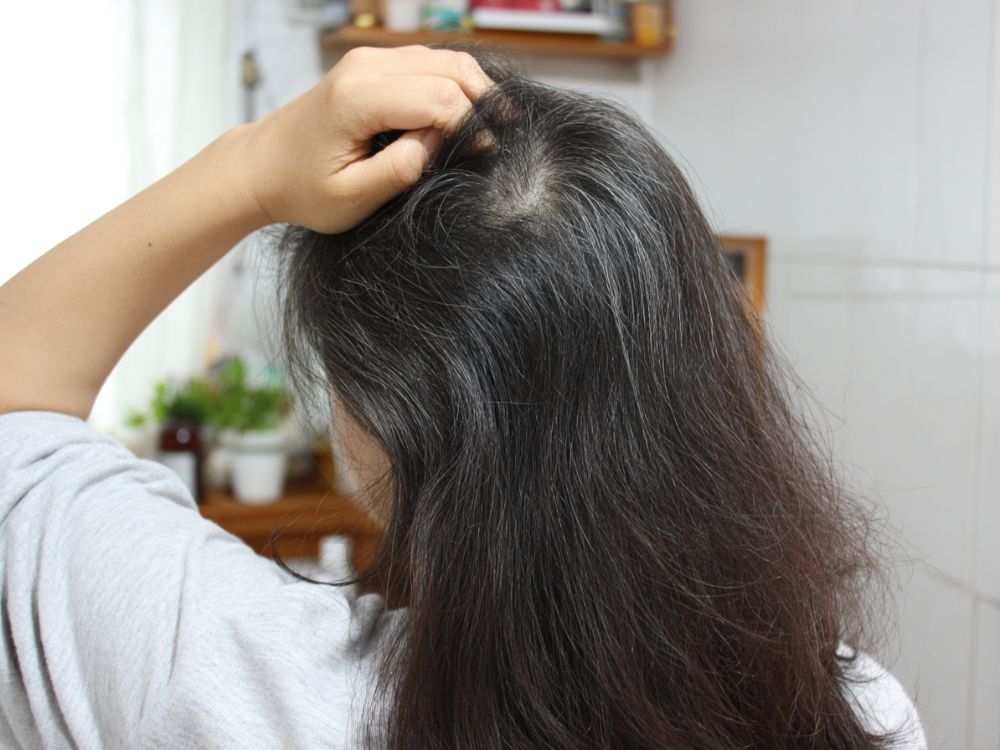
3. Professional Haircuts for Healthier Growth

Trimming your hair regularly prevents split ends from traveling up the hair shaft, ensuring healthier and longer strands over time.

🔗 Explore our full list of personalized haircut services to find the right cut for you.

4. Personalized Hair Growth Consultation

Not all hair is the same, which is why we offer one-on-one consultations to analyze your:
Scalp health
Hair texture & density
Daily hair care habits

We then create a customized hair care plan tailored to your growth goals.

Book An Appointment

Hair growth isn’t just about time, it’s about care, consistency, and professional support.

At De Arte Hair Salon, we combine science-backed techniques with luxurious treatments to ensure your hair grows longer, thicker, and healthier.

🌿 Book your appointment today and let’s bring out the best in your hair; because beautiful hair starts with healthy growth

Scalp Therapy: The Ultimate 9-Step Detoxifying Herb Infusion Scalp Treatment

Scalp Therapy - Detoxifying Herb Infusion

A healthy scalp is the foundation for luscious, vibrant hair. Detoxifying your scalp with herbal treatments can clear buildup, boost circulation, and restore your hair’s natural shine. Here’s a comprehensive guide to the Detoxifying Herb Infusion Scalp Therapy process that uses natural ingredients and advanced techniques to deeply cleanse, hydrate, and rejuvenate your scalp for optimal hair health.

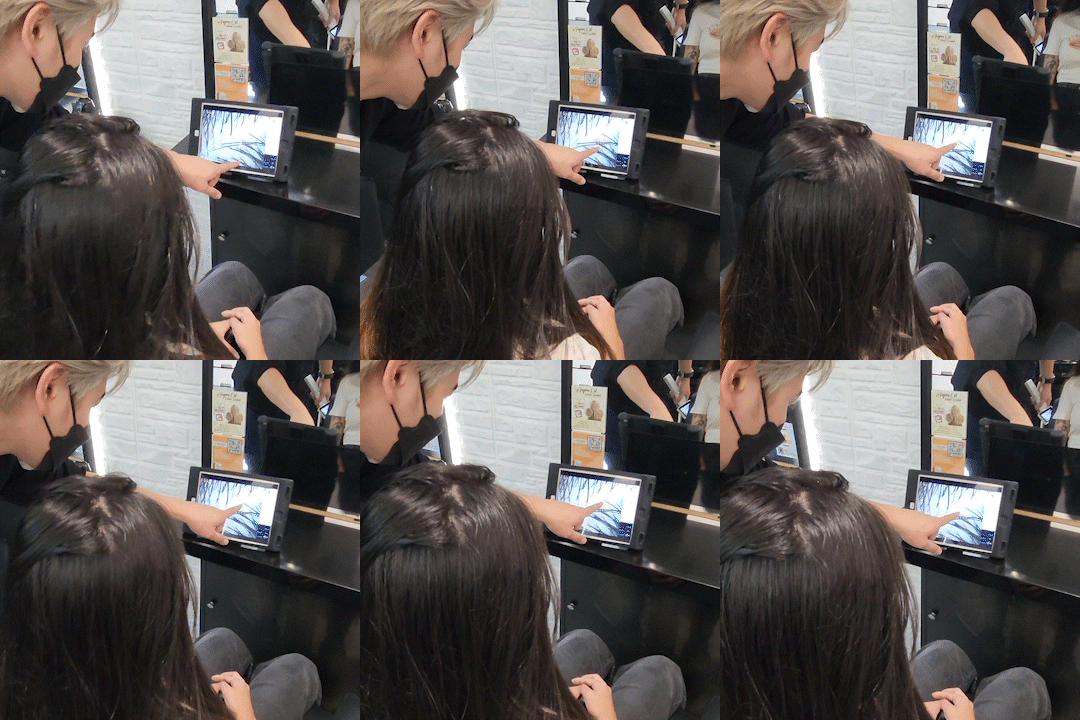
Scalp Therapy Scalp Analysis

Step 1: Scalp Analysis

Understand Your Scalp Condition

Before beginning any treatment, it’s crucial to assess your scalp’s unique needs. Whether you have an oily, dry, flaky, or sensitive scalp, our expert will help identify the underlying issues and ensure the right treatments are applied. This targeted approach in scalp therapy helps to achieve the best results without causing any damage.

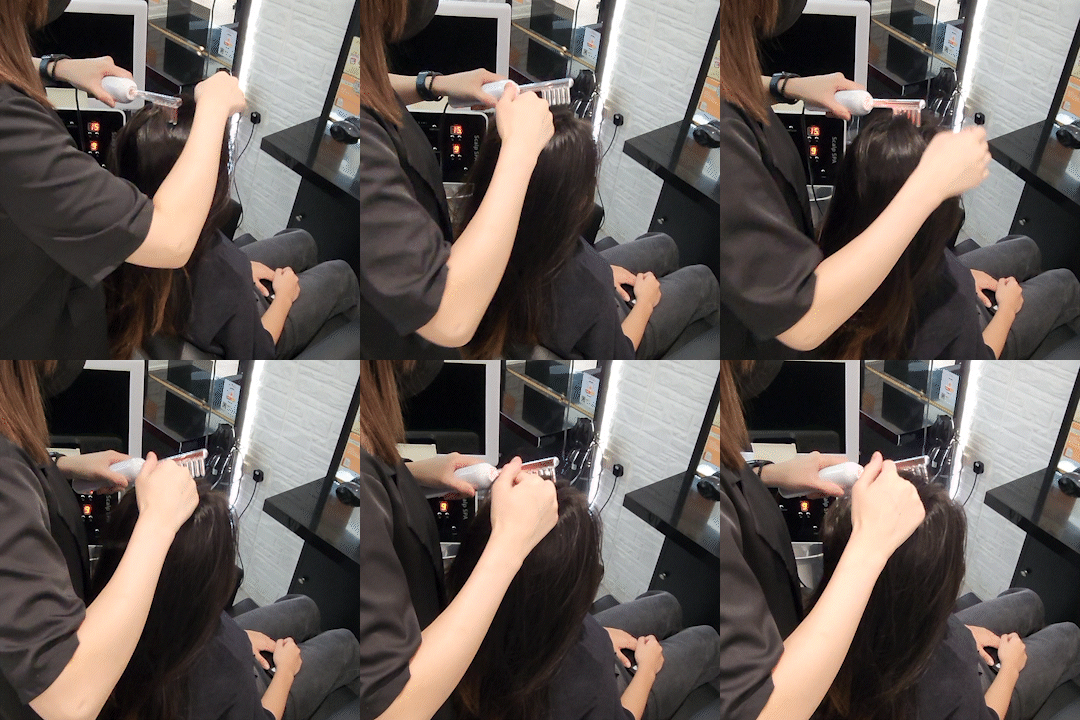
Scalp Therapy High Frequency Treatment

Step 2: High Frequency Treatment

Stimulate Scalp Health

A glass electrode wand emitting mild electrical currents is used to generate oxygen molecules and gently heat the scalp. This process stimulates collagen and elastin production, boosting circulation and encouraging cell renewal. The oxygen molecules work to eliminate acne-causing bacteria and toxins, making this step essential for a cleaner, healthier scalp environment. High-frequency scalp therapy is an important technique in scalp care that improves overall scalp health and hair growth.

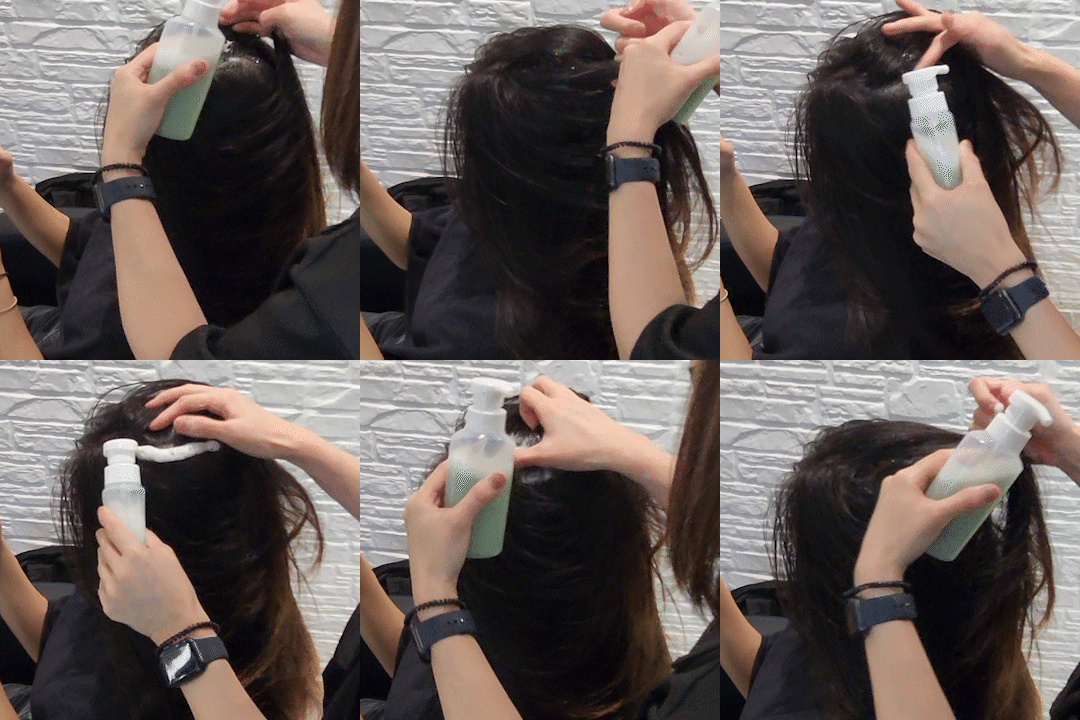
Scalp Therapy Bubble Cleansing

Step 3: Bubble Cleansing

Deeply Cleanse Without Stripping Moisture

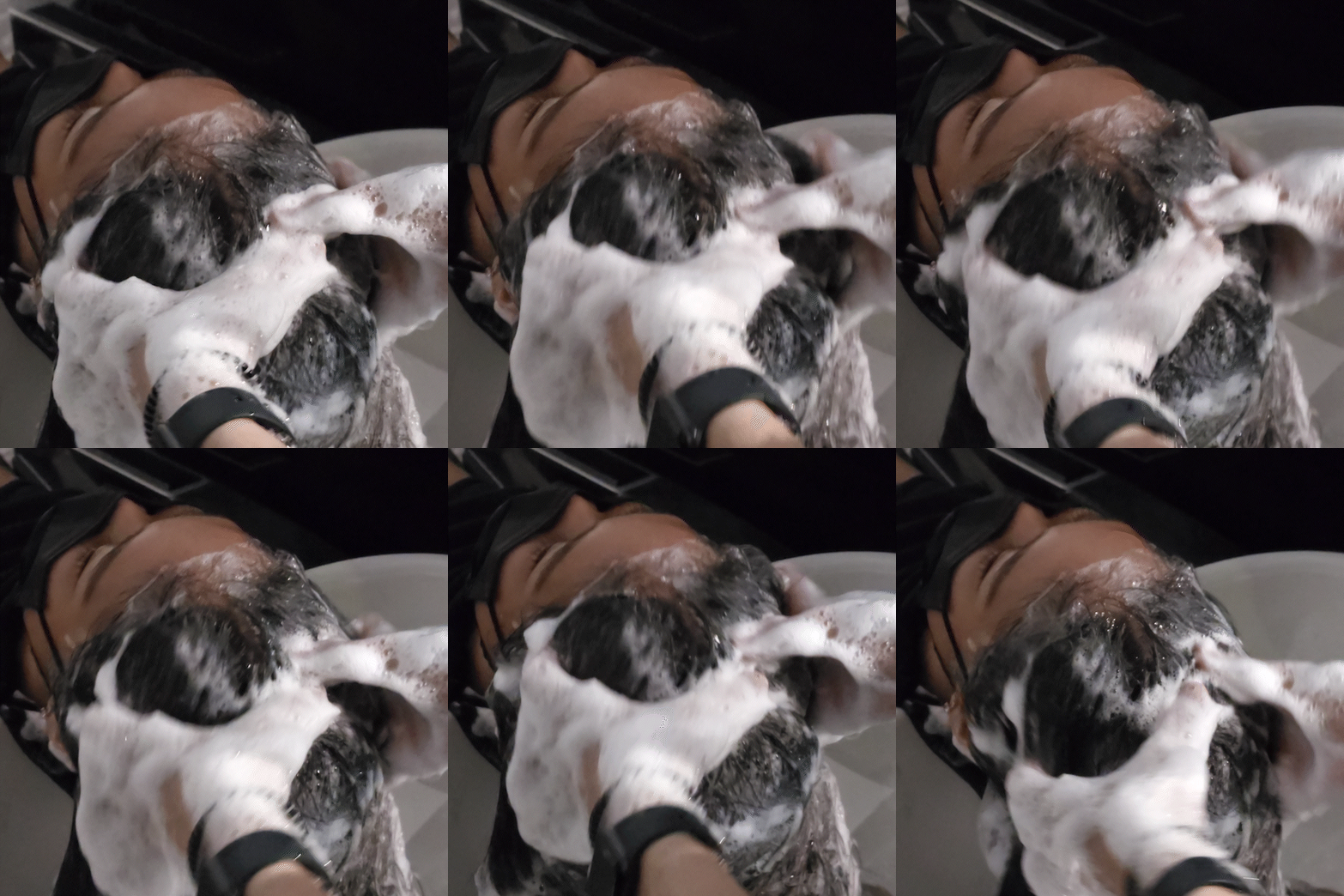
Using a specially formulated infusion of tea tree oil, soybean seed extract, avocado oil, and eucalyptus, this step deeply cleanses the scalp without disrupting the natural moisture balance of your hair. Tea tree oil has antifungal and antibacterial properties, while avocado oil nourishes the scalp with essential fatty acids. The bubble cleansing process gently removes impurities, leaving your scalp feeling fresh and revitalized. This is an essential part of a thorough scalp therapy treatment to detoxify and balance the scalp.

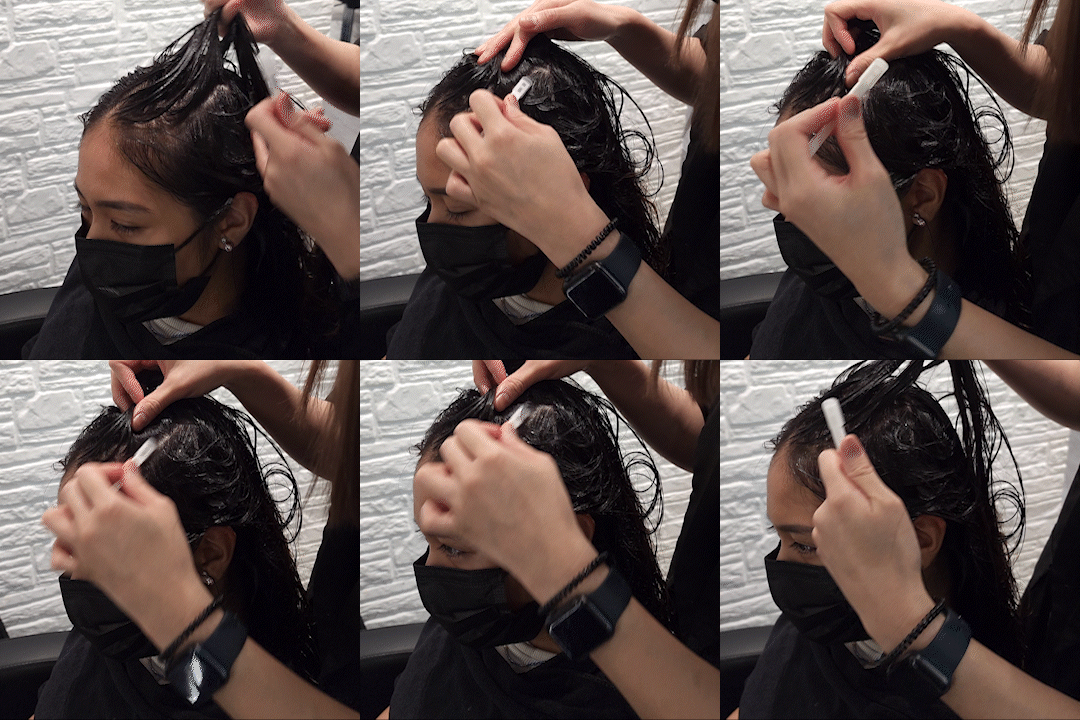
Scalp Therapy Exfoliation

Step 4: Exfoliation

Target Scalp Build-Up

Depending on your scalp condition, exfoliation may be necessary to remove dead skin cells, excess oil, or product buildup. This step promotes healthy skin renewal, encourages better absorption of subsequent treatments, and helps to prevent clogged hair follicles that can lead to hair thinning or scalp irritation. Exfoliation is a vital step in any scalp therapy to ensure the scalp remains clear of buildup.

Scalp Therapy Massage

Step 5: Massage

Boost Circulation and Enhance Absorption

A soothing scalp massage is performed to help distribute the products deeply into the skin and hair follicles. The massaging technique not only enhances product absorption but also improves blood flow to the scalp. This results in better nutrient delivery to the hair follicles, which can stimulate growth and promote a healthier scalp. Regular scalp therapy massages improve circulation, reduce stress, and boost overall scalp health.

Scalp Therapy Wash Rinse

Step 6: Wash & Rinse

Remove Impurities and Refresh the Scalp

After applying the products, a gentle wash will remove any remaining impurities and leave the scalp feeling clean and refreshed. The massage combined with a thorough rinse ensures all treatment residues are removed, preparing your scalp for the next step. This washing process is an integral part of the scalp therapy regimen to maintain cleanliness and balance.

Scalp Therapy Customised Treatment

Step 7: Apply Customised Treatment Mask

Tailor to Scalp Needs

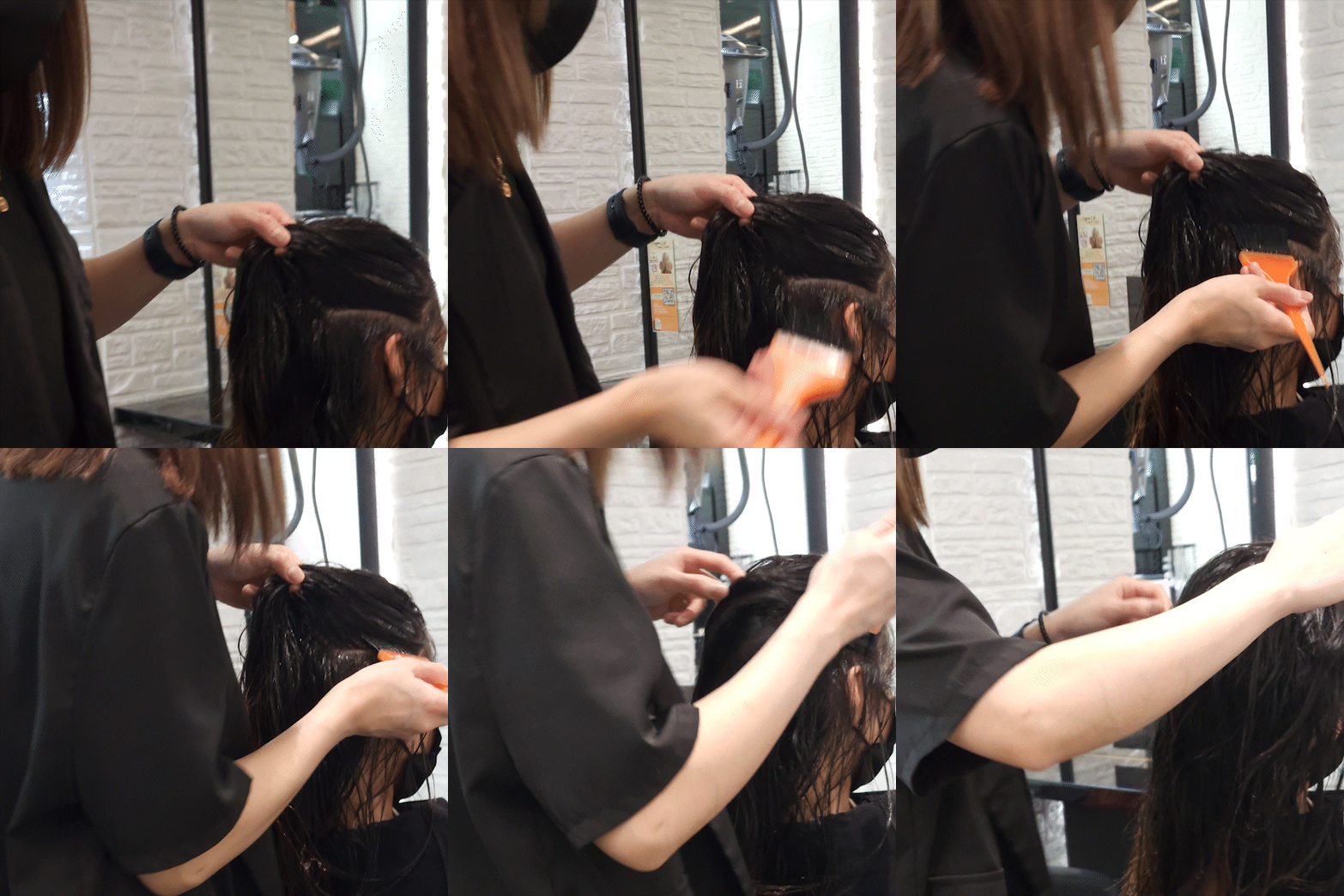
Depending on your specific scalp condition (e.g., oily, dry, or sensitive), a customized treatment mask is applied to address your concerns. These treatments are infused with plant-based oils, herbs, and vitamins, designed to nourish and rejuvenate the scalp and hair. Whether it’s hydrating or balancing, this step ensures that your scalp receives the exact care it requires. Customizing your scalp therapy helps target specific issues such as dryness, excess oil, or dandruff.

Scalp Therapy Head & Neck Massage

Step 8: Head & Neck Massage

Relieve Tension and Boost Circulation

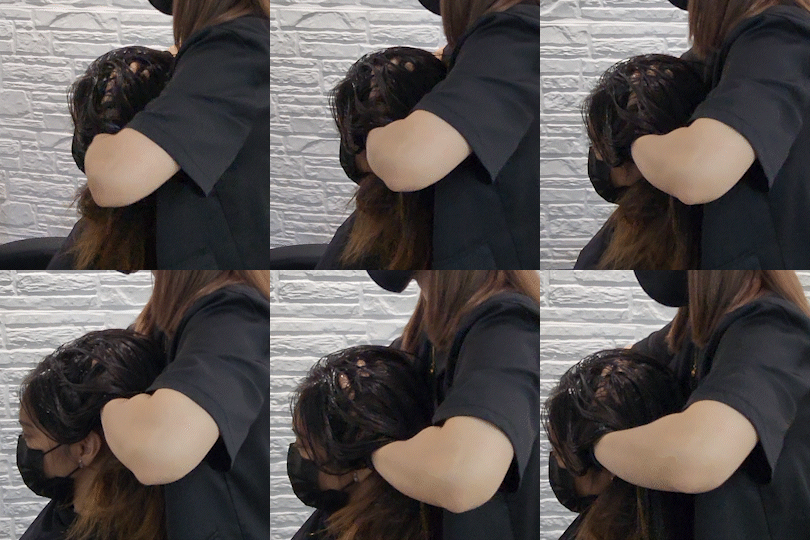
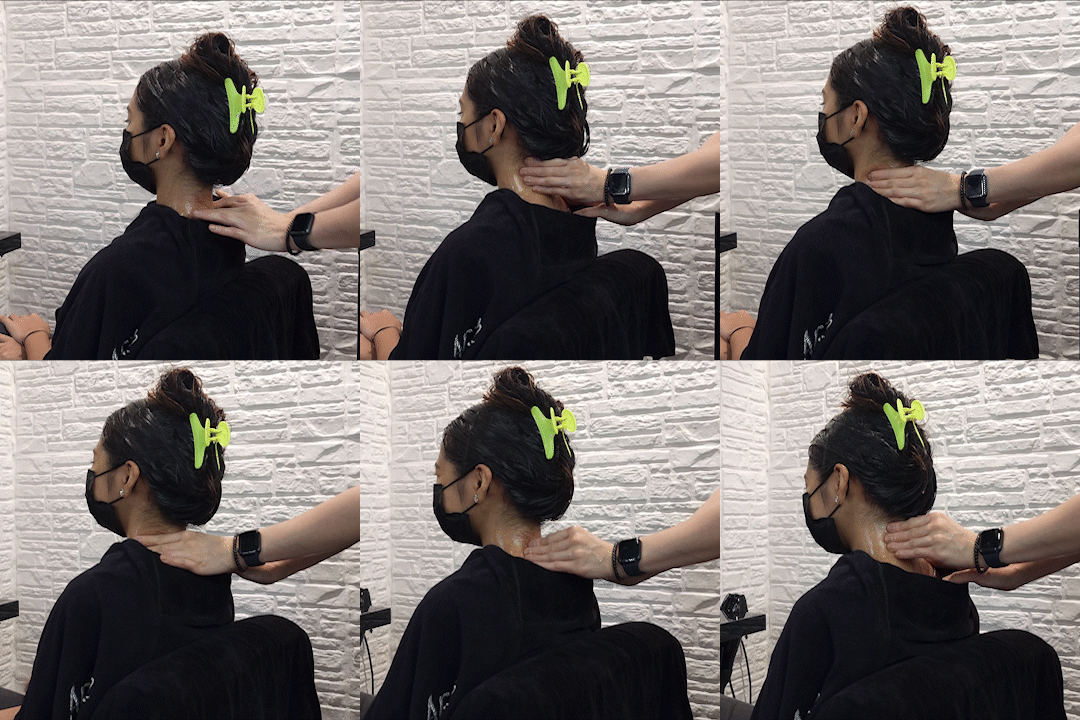
A relaxing head and neck massage follows, targeting key pressure points to alleviate tension and stress. This not only enhances circulation to the scalp but also improves overall relaxation and well-being. Increased blood flow promotes healthier hair follicles and a calmer, balanced mind. The head and neck massage is a key element in scalp therapy, helping to boost relaxation and support healthy scalp circulation.

Scalp Therapy Steaming

Step 9: Steaming

Maximize Treatment Absorption

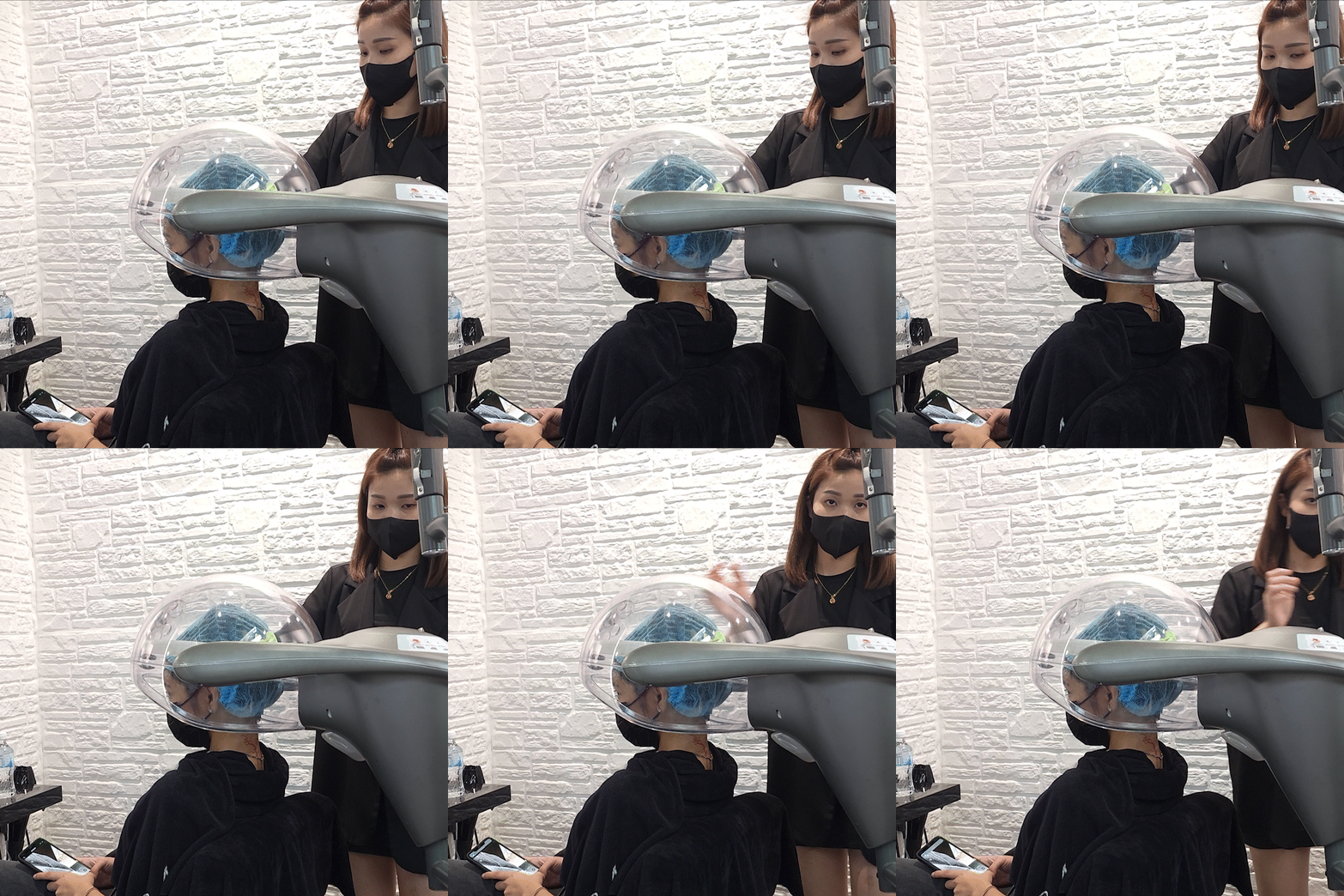
Steaming uses moist heat to open the pores on scalp, allowing the active ingredients in the treatment mask to penetrate deeply into the hair fibers. Unlike dry heat, which can lift the cuticle without allowing proper penetration, steam works gently to soften the scalp and hair cuticles, making them more receptive to treatments. This process maximizes hydration, nourishment, and moisture retention. Steaming is one of the most effective scalp therapy methods to ensure the best absorption of active ingredients, improving both scalp health and hair quality.

As a result...

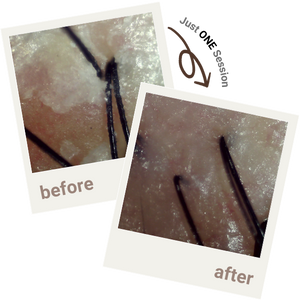
Scalp Treatment Before
Before Scalp Therapy Treatment
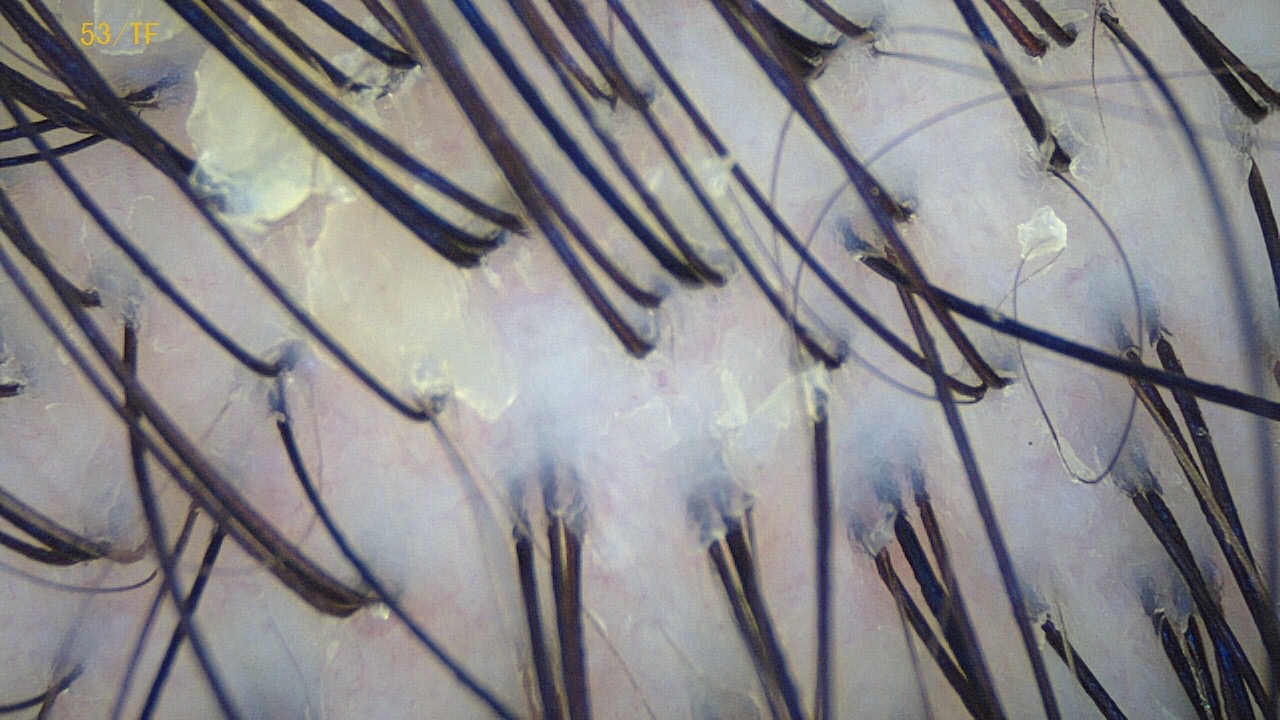
Build-up of dead skin cells, oil, and toxins that can lead to clogged hair follicles, irritation, or hair loss.
Scalp Treatment After
After Scalp Therapy Treatment
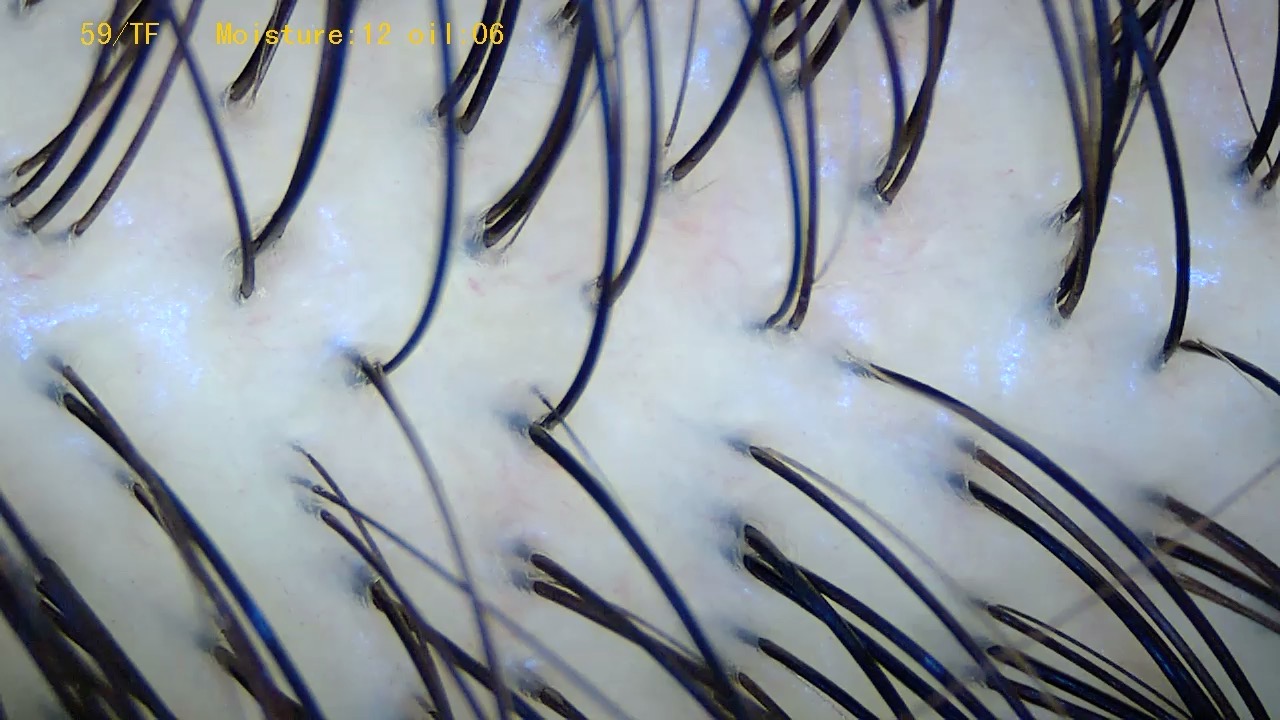
A refreshed, clean scalp with improved circulation, reduced buildup, and enhanced hair growth potential.

The Detoxifying Herb Infusion Scalp Therapy offers a comprehensive, natural approach to restoring your scalp’s health. With the power of herbal extracts, high-frequency stimulation, and targeted scalp care techniques, this treatment addresses a variety of scalp conditions to promote hair growth and overall scalp well-being. Rejuvenate your scalp, restore balance, and enjoy healthier, shinier hair with this effective 9-step scalp therapy.

Aftercare Tips: Maintaining a Healthy Scalp Post-Therapy

To extend the benefits of your Detoxifying Herb Infusion Scalp Therapy, incorporating a thoughtful aftercare routine with targeted products can help maintain a healthy scalp and promote vibrant hair. Here are some recommendations:

1. Regular Scalp Exfoliation

Gently exfoliating your scalp once a week can help remove dead skin cells and product buildup, promoting a healthier environment for hair growth. This process can also enhance the effectiveness of other hair care products by improving their absorption.

2. Scalp Massage

Do a simple DIY scalp massage to help boost blood flow to your hair follicles, which can support healthy hair growth and help you relax. You can follow this link for easy step-by-step instructions.

3. Cleanse with the Right Shampoo

Maintaining a healthy scalp is essential for vibrant, healthy hair. Incorporating shampoos infused with plant-derived ingredients can significantly enhance scalp health. These shampoos provide gentle cleansing while delivering essential nutrients, promoting overall hair vitality.

For Normal to Dry Scalp:

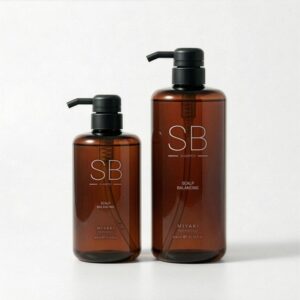
Miyaki Scalp Balancing Shampoo (SB) balances the scalp's environment to prevent dryness and frizz, making it suitable for normal or dry scalps experiencing hair loss.

For Oily Scalp:

Miyaki Root Balancing Shampoo (RB) helps regulate excess oil production, adding volume for a fuller appearance. This shampoo is ideal for oily scalps dealing with hair loss.

For Dry or Damaged Hair:

Miyaki Repairing Shampoo (RP) provides deep hydration and nourishment from roots to tips, repairing dry and damaged hair.

4. Application of Scalp Treatments

To further nourish and strengthen your hair, consider incorporating specialized scalp treatments:

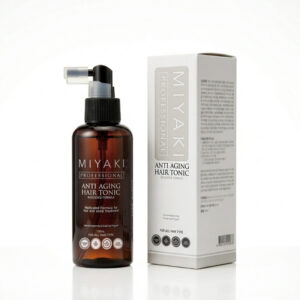
Miyaki Anti-Aging Hair Tonic:
Formulated with botanical extracts rich in minerals and nutrients, this tonic strengthens hair follicles and promotes hair growth, addressing hair loss and thinning.

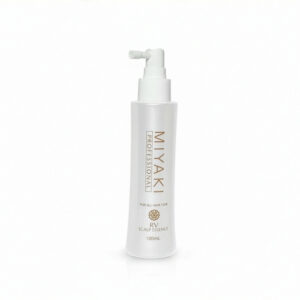
Miyaki RV Scalp Essence:
This essence revitalizes the scalp, ensuring it remains nourished and balanced, which is essential for sustaining the benefits of your detoxifying therapy.

By integrating these practices and products into your aftercare routine, you can effectively maintain a healthy scalp and promote vibrant hair, extending the benefits of your detoxifying therapy.

Book An Appointment

Ready to give your scalp the nurturing environment it deserves?

Book an appointment today and let our expert guide you through a customized Detoxifying Herb Infusion Scalp Therapy. Rejuvenate your scalp, restore balance, and enjoy healthier, shinier hair with our tailored treatments. Your hair’s healthiest future starts here!